

Building a minimum viable product on no-code platforms has revolutionised how startups bring ideas to market, but security remains a critical consideration that cannot be overlooked. Bubble security encompasses the comprehensive set of practices, features, and configurations that protect your application's data, users, and infrastructure from unauthorised access and breaches. For entrepreneurs and founders launching MVPs, understanding these security fundamentals ensures your product gains user trust whilst meeting regulatory compliance requirements from day one.
When developing applications on Bubble, security operates on a shared responsibility model between the platform and developers. The platform itself provides robust infrastructure-level protections, whilst application builders must implement proper privacy rules and access controls.
Bubble hosts all applications on Amazon Web Services infrastructure, providing enterprise-grade security features including data encryption both in transit and at rest. The platform maintains SOC 2 Type II compliance and adheres to GDPR requirements, establishing a solid foundation for secure application development.
However, this foundation alone does not guarantee a secure application. Developers bear responsibility for configuring privacy rules, implementing authentication workflows, and ensuring sensitive data remains protected through proper application logic. Understanding this division of responsibility is crucial for anyone building on the platform.

The infrastructure supporting your Bubble application includes several built-in security measures that operate automatically:
These features provide baseline protection without requiring developer intervention. The platform's security team continuously monitors for vulnerabilities and applies updates to address emerging threats.
Privacy rules form the cornerstone of bubble security at the application level. These rules determine which data users can access, modify, or delete based on their roles and relationships to that data.
Many security vulnerabilities in Bubble applications stem from insufficient or incorrectly configured privacy rules. Without proper rules, data may become accessible to unauthorised users through API endpoints or database queries.
Each data type in your application requires carefully considered privacy rules. Start with a default deny-all approach, then explicitly grant access where needed.
| Rule Type | Purpose | Example Use Case |
|---|---|---|
| View rules | Control who can see records | Users view only their own profile data |
| Create rules | Determine who can add records | Authenticated users create new posts |
| Modify rules | Define who can edit existing data | Users edit their own account settings |
| Delete rules | Specify who can remove records | Administrators delete inappropriate content |
When configuring privacy rules, consider both direct access and indirect access through relationships. A user might not have permission to view another user's data directly, but could potentially access it through a related record if rules are not properly cascaded.
The privacy rules documentation emphasises testing these configurations thoroughly before launching your application. Use Bubble's debugger to verify that data appears only to authorised users under various scenarios.
Secure authentication forms the gateway to your application. Implementing robust user authentication prevents unauthorised access and establishes the foundation for all subsequent security measures.
Bubble provides built-in authentication workflows, but developers must configure these properly to maintain bubble security standards. Weak authentication implementations create vulnerabilities that attackers can exploit to gain unauthorised access.
Modern authentication requires multiple layers of protection beyond simple username and password combinations:
Consider implementing user authentication best practices that match your application's risk profile. Financial applications require stricter controls than basic content platforms.
For startups building their first MVP, balancing security with user experience presents a common challenge. Overly restrictive authentication may discourage early adopters, whilst lax controls expose the application to risks. When developing MVP solutions, finding this balance becomes crucial for both user adoption and data protection.
Bubble applications execute significant logic on the client side, meaning users' browsers process and temporarily store data. Understanding the security implications of client-side operations prevents inadvertent data exposure.
Page security settings control what data reaches users' browsers in the first place. Even with privacy rules in place, developers must ensure sensitive data never loads on the client side unnecessarily.
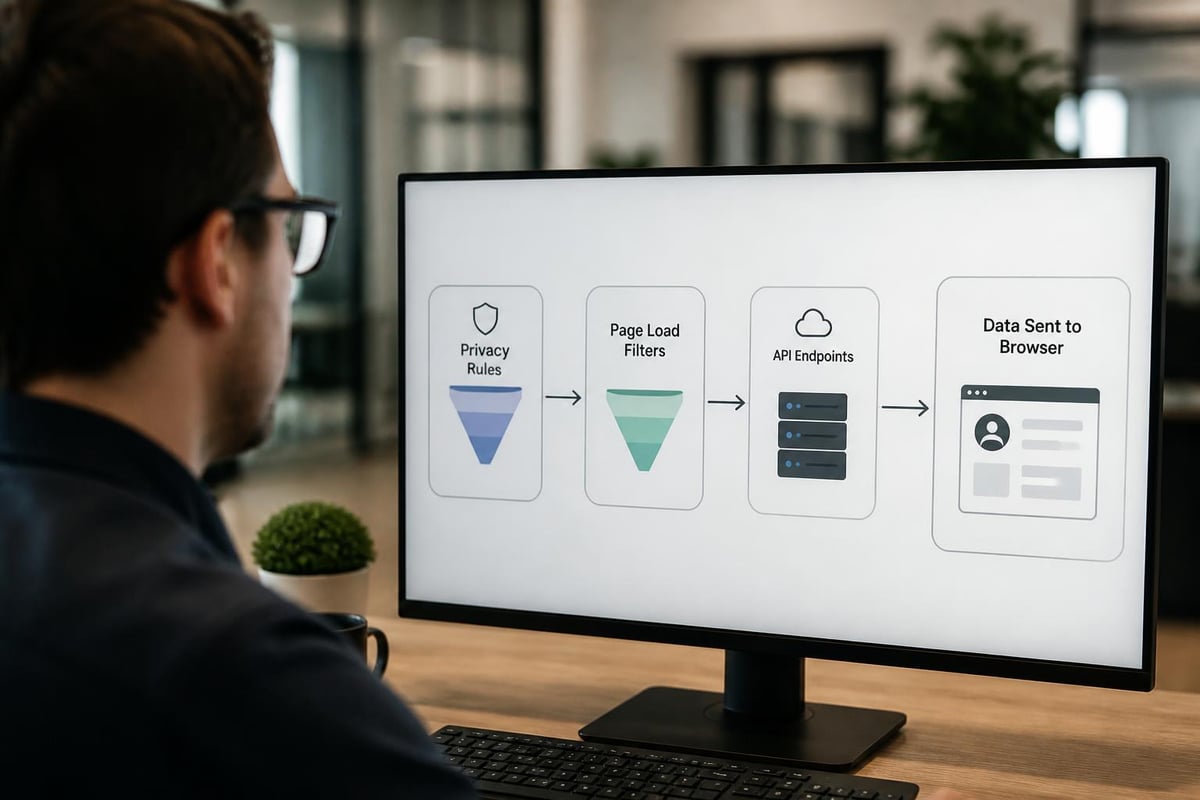
Several strategies minimise the risk of exposing sensitive information through client-side operations:
When building dynamic interfaces, developers sometimes load more data than necessary for convenience. This practice creates security risks, as technically proficient users can inspect browser data to view information beyond their intended access level.
Modern applications rarely operate in isolation. Most MVPs integrate with external services for payments, communications, analytics, and other functionality. Each integration point represents a potential security consideration.
API keys, webhook URLs, and authentication tokens require careful protection. Exposing these credentials allows unauthorised parties to access external services or intercept data flowing between systems.
When working with external services, implement these security measures:
| Security Measure | Implementation | Risk Mitigation |
|---|---|---|
| Server-side API calls | Use backend workflows | Prevents credential exposure in browser |
| Environment variables | Store sensitive keys separately | Facilitates secure credential rotation |
| Webhook verification | Validate incoming requests | Prevents spoofed data injection |
| Rate limiting | Restrict API call frequency | Reduces abuse and cost exposure |
| HTTPS enforcement | Use secure protocols exclusively | Protects data in transit |
The Bubble security checklist provides comprehensive guidance for securing API integrations. Review this checklist regularly, particularly when adding new external services to your application.
Integrating payment systems like Stripe requires particular attention to bubble security practices, as financial data demands the highest protection standards.
Security represents an ongoing process rather than a one-time configuration. Regular audits identify vulnerabilities before malicious actors exploit them.
Conducting security reviews becomes particularly important after significant application updates or feature additions. New workflows and data types may introduce security gaps if not properly reviewed.
A comprehensive security audit for Bubble applications should examine:
Common security vulnerabilities in Bubble applications often arise from overlooked configuration details rather than platform weaknesses. Systematic auditing catches these oversights before they become problems.
Beyond technical security measures, applications must comply with data protection regulations applicable to their users and operations. GDPR in the UK and Europe, CCPA in California, and other regional regulations impose specific requirements on how applications collect, store, and process personal data.
Bubble security features support compliance efforts, but developers must actively implement compliant practices within their applications. The platform's GDPR-ready infrastructure provides a foundation, but application-specific compliance measures remain the developer's responsibility.

Consider these compliance requirements from your application's inception:
Whilst Bubble addresses infrastructure-level compliance, application developers must ensure their specific implementation meets regulatory requirements. This includes configuring privacy rules to respect user preferences and implementing workflows for data subject rights.
Beyond privacy rules and authentication, Bubble provides application-level security settings that control broad aspects of your application's security posture. These application security configurations determine fundamental access patterns and restrictions.
Review and configure these settings deliberately rather than accepting defaults. Default settings prioritise development convenience over production security, making explicit configuration essential before launching.
Several key settings significantly impact bubble security:
Configure these settings according to your application's current stage. Development and staging environments might use permissive settings for testing convenience, but production applications require restrictive configurations.
Even experienced developers make security mistakes when building Bubble applications. Awareness of common pitfalls helps avoid introducing vulnerabilities into your MVP.
Recent security incidents have highlighted how no-code platforms can be abused for phishing campaigns, emphasising the importance of proper security configurations to prevent misuse.
Watch for these common mistakes that compromise bubble security:
When choosing a development partner, prioritise those who demonstrate security expertise. Quality development agencies understand these pitfalls and implement proper security measures from the outset.
Thorough security testing before launching your MVP identifies vulnerabilities whilst they remain easy to fix. Testing should examine both automated vulnerability scans and manual security review processes.
Use Bubble's built-in testing tools to verify privacy rules function as intended. The debugger allows you to view your application as different user types, confirming that data access restrictions work correctly.
Complete this verification checklist before making your application publicly available:
Understanding development costs should include time allocated for proper security testing. Rushing through this phase to save time or money creates technical debt that becomes far more expensive to address post-launch.
Security work does not end at launch. Ongoing maintenance keeps your application secure as threats evolve and your feature set expands.
Establish processes for security updates and monitoring. This includes staying informed about platform security updates, reviewing application logs for suspicious activity, and conducting periodic security audits.
Regular security maintenance should include reviewing user access patterns, monitoring API usage for anomalies, updating external service credentials periodically, and ensuring new features maintain security standards consistent with existing functionality.
Consider security implications whenever adding features or modifying existing workflows. Each change represents an opportunity to introduce vulnerabilities if not properly reviewed through a security lens.
Implementing robust bubble security measures protects both your application and your users whilst building trust with your target market. The shared responsibility model between platform and developer means success requires attention to infrastructure capabilities and application-specific configurations equally.
Whether you are launching your first MVP or scaling an existing application, security must remain a foundational priority rather than an afterthought. Creator Concepts specialises in building secure, scaleable Bubble applications that protect user data whilst delivering exceptional functionality, helping entrepreneurs and startups launch with confidence from our Canary Wharf base.
© 2026 CreatorConcepts Limited
128 City Road, London EC1V 2NX