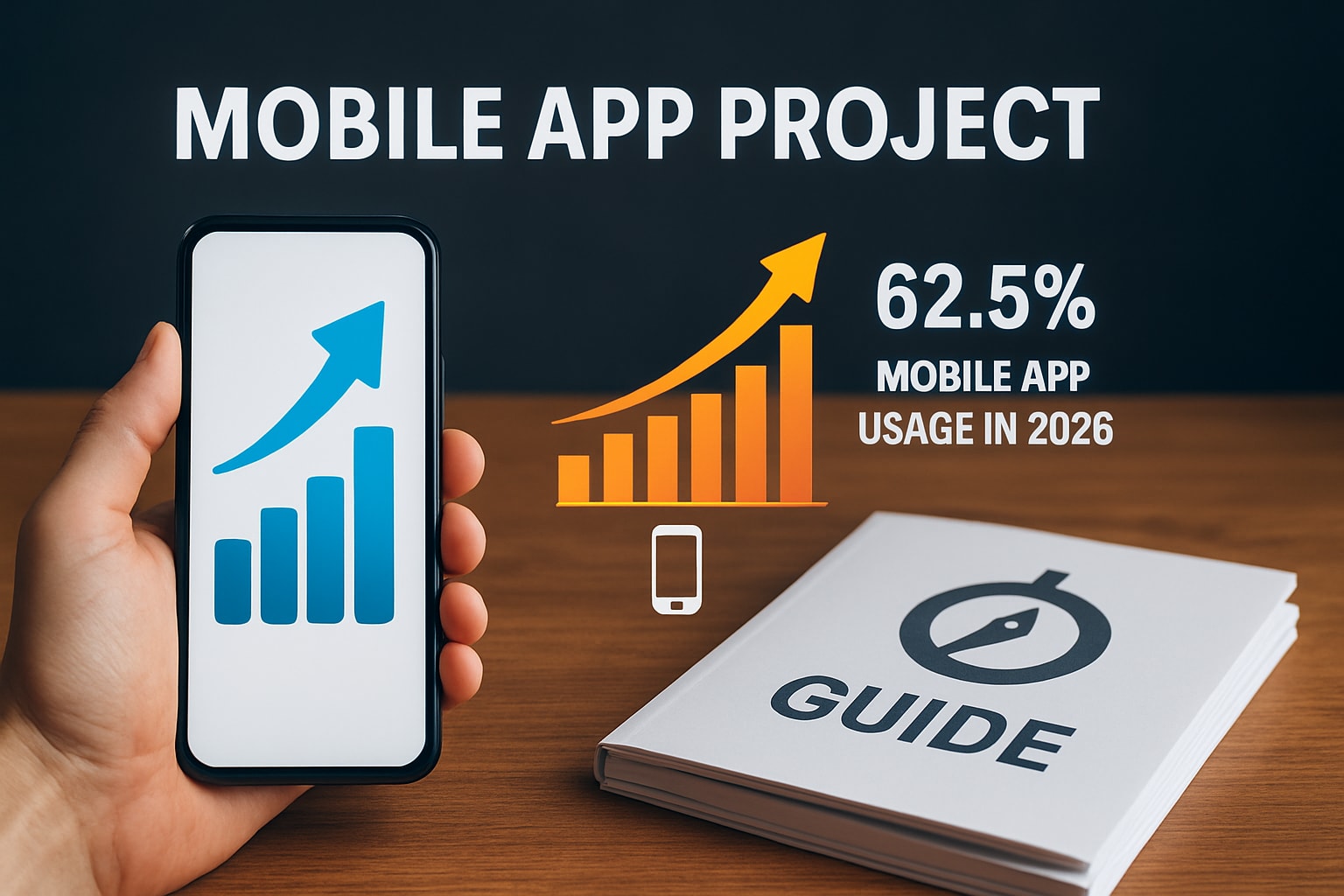

Did you know that in 2026, over 62.5% of global internet traffic comes from mobile devices? This unprecedented surge means every business, startup, and entrepreneur must master the mobile app project landscape to stay ahead.
This essential guide will empower you to navigate each critical stage of a mobile app project, from strategic planning and team building to technology selection, user-centred design, thorough testing, launch, and ongoing optimisation.
Are you ready to overcome common challenges and turn your app vision into reality? Discover proven strategies and practical insights designed for success in 2026.
Strategic planning is the cornerstone of any successful mobile app project. Before you write a single line of code, it is essential to lay a foundation that aligns your vision with measurable outcomes and market needs.

Start by clarifying the core purpose of your mobile app project. Ask yourself, what problem does the app solve, and for whom? Clear objectives act as the guiding star for your team.
Set Key Performance Indicators (KPIs) to measure progress. These could include:
For example, a fintech mobile app project might target a 30% increase in user retention within six months. By establishing these KPIs early, you can steer your team towards tangible results.
Thorough research is vital for gaining a competitive edge. Analyse top competitors on Google Play and the App Store, noting their features, reviews, and user feedback.
Use surveys and interviews to uncover user pain points. Analytics tools can help you understand market gaps and opportunities. According to the Mobile Application Market Size, Share | 2026, the mobile app sector’s growth will be driven by evolving user behaviour and rapid technological change. Leading apps invest significantly in competitor analysis to refine their value proposition and secure long-term success.
Define the must-have features for your mobile app project. Focus on your Minimum Viable Product (MVP) — the version with just enough functionality to satisfy early users and gather feedback.
Avoid feature bloat. Prioritise features that directly support your core objectives. Take inspiration from Instagram’s original MVP, which focused solely on photo sharing before expanding.
List your features under "MVP" and "Future Enhancements" to maintain clarity and prevent scope creep. This targeted approach keeps development efficient and user-focused.
Selecting the right platforms is crucial for your mobile app project. Decide whether to build native apps for iOS and Android, or opt for cross-platform solutions like Flutter or React Native.
Consider device usage trends. In 2026, cross-platform frameworks are expected to power 60% of new mobile app projects, offering efficiency and broader reach.
| Platform | Pros | Cons |
|---|---|---|
| Native (iOS/Android) | Optimal performance, full device access | Higher cost, longer development |
| Cross-platform | Faster delivery, lower cost | May have performance trade-offs |
Align your choice with both your budget and your target audience.
Break down the costs for your mobile app project into design, development, QA, marketing, and maintenance. Use this breakdown to set a realistic budget and avoid surprises later.
Estimate timelines for each major milestone: MVP, beta release, and full launch. Proper planning at this stage reduces the risk of delays by over 40 percent.
A Gantt chart or Kanban board can help visualise the schedule and keep your team on track.
A well-defined go-to-market strategy will set your mobile app project up for early traction. Identify acquisition channels such as App Store Optimisation, social media, influencer partnerships, and paid advertising.
Plan pre-launch activities to generate buzz. Engage early adopters through beta access or exclusive previews. Early engagement often leads to valuable user feedback and word-of-mouth growth.
Every mobile app project faces risks. Identify technical, market, and compliance risks as early as possible. For each risk, create a contingency plan.
Common risk categories include:
By proactively addressing these risks, you strengthen your project’s resilience and ensure smoother delivery.
Assembling the right team lays the foundation for a successful mobile app project. The expertise and alignment of your development team will influence every stage, from ideation through launch and beyond. Whether you are a startup, SME, or an established business, the structure and collaboration of your team can directly impact project outcomes.
Every mobile app project benefits from a well-defined team structure. At minimum, you should bring together these core roles:
A typical mobile app project team includes at least five core members, allowing for seamless collaboration and coverage of all critical functions. Clearly outlining responsibilities minimises confusion and ensures accountability throughout the project lifecycle.
Selecting the right development approach is a pivotal decision for your mobile app project. In-house teams offer deep integration with your company culture and close control, but may lack the specialised skills or scalability needed for complex builds. Freelancers provide flexibility and cost savings but can introduce challenges with consistency and communication.
Agencies, on the other hand, deliver comprehensive expertise and end-to-end service, making them a popular choice for mobile app projects in 2026. In fact, 55% of businesses now opt for agency partnerships to streamline delivery and mitigate risk. For an in-depth comparison of top partners, explore this Best mobile app development agency guide.
Robust collaboration is essential for any mobile app project. Establish clear communication channels using tools like Slack, Jira, or Trello. Schedule regular stand-ups and sprint reviews to maintain momentum and transparency.
Teams that conduct weekly check-ins report a 30% higher success rate for their mobile app project. Consistent updates enable quick problem-solving and keep everyone aligned on priorities.
Stakeholder alignment is critical for a mobile app project’s success. Involve key stakeholders from the outset to clarify the vision, set expectations, and secure buy-in. Use shared documentation and roadmapping tools to maintain transparency and traceability.
Early and ongoing involvement reduces the risk of misunderstandings and ensures that the development team delivers on business objectives. This approach fosters trust and smooths the path to a successful launch.
A thriving mobile app project relies on open feedback loops between design, development, and business teams. Encourage team members to share insights, flag issues early, and suggest improvements at every stage.
Iterative reviews and constructive feedback help refine features, improve user experience, and adapt to changing requirements. This culture of iteration is vital for continuous improvement and long-term project success.
No-code platforms such as Bubble.io are revolutionising the way businesses approach mobile app projects. Agencies like Creator Concepts, based in Canary Wharf, specialise in building secure, scalable no-code mobile apps with rapid turnaround. MVPs can be delivered in as little as one to two weeks, leveraging AWS-backed security and transparent planning.

For startups and SMBs, no-code agencies provide a cost-effective route to market, ongoing support, and the flexibility to iterate quickly as user needs evolve.
A successful mobile app project in 2026 depends on more than innovation, it demands a relentless focus on the user. Every decision, from the first wireframe to post-launch updates, must put real people at the centre. By prioritising user-centred design, you ensure your mobile app project is not just functional but memorable and valuable.

Start every mobile app project by stepping into your users’ shoes. Develop detailed personas using real research, such as interviews and surveys. These personas reveal needs, motivations, and behaviours, helping you craft experiences that resonate.
Map out user journeys for each persona. Visualise every step, from opening the app to achieving their goals. For instance, e-commerce teams map the checkout journey to uncover friction points. This approach helps identify where users might get stuck, allowing you to refine your mobile app project for smoother navigation.
Journey mapping ensures your mobile app project is rooted in empathy and insight.
An intuitive interface is the backbone of every mobile app project. In 2026, users expect seamless navigation, consistent design across devices, and accessible features for all. Use industry-standard tools like Figma, Sketch, or Adobe XD to build wireframes and interactive prototypes.
Adopt familiar design patterns, such as bottom navigation bars in social apps, to reduce the learning curve. Remember, 88% of users abandon apps with poor UX—a risk no mobile app project can afford. For actionable insights on crafting effective interfaces, consult the Effective user interface design in Bubble.io guide.
By following best practices, your mobile app project stands out in a crowded marketplace.
Early prototyping is essential to validate your mobile app project’s vision. Create clickable prototypes to simulate real interactions. Share these prototypes with real users and gather honest feedback before development begins.
Usability testing uncovers overlooked issues and highlights what delights or frustrates users. Test across various devices and platforms to ensure consistent experiences. Incorporate findings into your design, refining your mobile app project with each iteration.
Iterative testing reduces costly changes later in your mobile app project lifecycle.
Your mobile app project benefits from leveraging established design conventions. Familiar patterns, like swipe gestures or floating action buttons, make navigation intuitive for users. These patterns lower the barrier to entry, allowing users to focus on value rather than learning new layouts.
Review top apps in your niche to identify which patterns resonate with your audience. Adapt and refine these patterns to fit your mobile app project’s unique goals, ensuring a balance between innovation and usability.
Aligning your mobile app project with familiar patterns fosters trust and drives engagement.
An inclusive mobile app project welcomes everyone, regardless of ability. Design with accessibility in mind by following WCAG guidelines and ensuring compatibility with assistive technologies. Offer features like adjustable text sizes, voice commands, and high-contrast modes.
Test your mobile app project with users of varying abilities to uncover barriers. Small adjustments, such as clear labels and logical tab orders, make a significant difference. By championing inclusivity, your mobile app project not only meets legal requirements but also expands its reach.
Accessible design elevates your mobile app project and demonstrates a genuine commitment to all users.
The launch of your mobile app project is just the beginning. Post-launch, gather feedback through analytics, reviews, and direct user input. Monitor user flows to identify drop-off points and pain areas.
Schedule regular updates to address issues and introduce enhancements. Engaging with your user base and acting on their feedback ensures your mobile app project evolves alongside their needs.
Continuous iteration is key to keeping your mobile app project competitive and user-focused.
Selecting the right tech stack is crucial for any mobile app project. Your choices here shape performance, user experience, and future scalability. With technology evolving rapidly in 2026, making informed decisions at this stage maximises your project's success and longevity.

Choosing between native and cross-platform development is a pivotal decision for your mobile app project. Native apps use Swift for iOS and Kotlin for Android, delivering top-tier performance and seamless integration with device features. Cross-platform frameworks like Flutter and React Native allow you to build once and deploy on both platforms, saving time and budget.
Here is a quick comparison:
| Approach | Languages/Frameworks | Pros | Cons |
|---|---|---|---|
| Native | Swift, Kotlin | High performance, best UX | Higher cost, separate codebases |
| Cross-Platform | Flutter, React Native | Shared codebase, faster MVP delivery | Slightly lower performance, plugin limits |
In 2026, cross-platform frameworks are chosen in 60% of new mobile app project launches, reflecting their maturity and efficiency. For a deeper dive into emerging trends like AI integration and 5G, explore the Top 10 Trends in Mobile App Development for 2026.
A solid backend is the backbone of any mobile app project. Evaluate scalable solutions such as Firebase, AWS, or a custom API tailored to your needs. Consider your app's future—will you need AI, payment gateways, or advanced analytics? Plan for these integrations early.
Popular backend options include:
Choosing wisely at this stage ensures your mobile app project remains adaptable as user demand grows.
Data security is non-negotiable for every mobile app project. Implement encryption for data in transit and at rest. Adopt secure authentication methods, like OAuth or biometrics, to protect user data.
Stay compliant with regulations such as GDPR, especially if handling sensitive information. Learning from past incidents, such as FaceApp’s 2019 privacy scrutiny, reinforces the need for robust protection from day one.
Scalability must be at the forefront of your mobile app project plan. Architect your app using cloud hosting, microservices, and caching strategies to handle growth smoothly. This not only boosts reliability but also minimises outages as your user base expands.
Apps optimised for scalability experience 40% fewer performance issues post-launch. Invest in flexible infrastructure now to avoid costly refactoring later.
Modern users expect seamless payments, instant notifications, and rich analytics in any mobile app project. Integrate trusted third-party services for these features:
Always vet plugins for security and compatibility to maintain high standards across your app.
The methodology you choose can make or break your mobile app project. Agile sprints offer flexibility and continuous improvement, ideal for fast-paced teams and evolving requirements. Waterfall suits projects with well-defined scopes and fixed deliverables.
Assess your team's size, experience, and preferred workflows before deciding. Adopting the right approach ensures your project stays on track, on time, and within budget.
Launching a successful mobile app project in 2026 demands a rigorous approach to quality assurance, thorough testing, and strategic launch preparation. As competition intensifies and user expectations rise, robust QA processes are no longer optional—they are essential to achieving reliability, user satisfaction, and app store success.
Quality assurance begins with defining a comprehensive testing strategy for your mobile app project. This includes functional testing to ensure features work as intended, usability testing to validate the user experience, performance testing under various loads, and security testing to safeguard user data.
It is vital to test across different devices and operating systems, as fragmentation can reveal unexpected issues. Statistics show that dedicated QA reduces critical post-launch bugs by 70 percent, making it a cornerstone of every mobile app project.
Choosing the right mix of automated and manual testing is crucial for a mobile app project. Automated tests are ideal for repetitive tasks, regression testing, and ensuring core functionalities remain intact after updates.
Manual testing, on the other hand, excels at uncovering user experience issues and edge cases that automation might overlook. For instance, automated regression tests can quickly identify recurring bugs, while manual testers can spot subtle UX flaws.
A balanced approach accelerates the development cycle, maintains high quality, and helps your mobile app project stay on schedule.
Before launching your mobile app project, beta testing is indispensable. By recruiting early adopters, you gain real-world validation and uncover usability improvements that may not surface in internal testing.
Implement structured feedback loops, such as in-app surveys or dedicated feedback channels, to capture actionable insights. Incorporating user feedback at this stage leads to last-minute refinements and a smoother launch.
For step-by-step advice tailored to startups navigating this process, consult the App development for startups guide.
Submitting your mobile app project to the App Store and Google Play requires meticulous preparation. Ensure all metadata, screenshots, and descriptions comply with platform guidelines.
Apps that include preview videos often see 25 to 35 percent higher conversion rates, so invest in compelling visuals. Double-check for any policy updates or new requirements in 2026 to avoid submission delays.
A well-prepared submission package speeds up approvals and sets your mobile app project up for early traction.
App Store Optimisation is vital for discoverability and download growth. Research high-traffic keywords to use in your app title and description, and integrate them naturally.
Eye-catching icons and screenshots can significantly boost download rates. Regularly update your ASO strategy to stay ahead of evolving trends and ensure your mobile app project remains competitive.
A strategic launch campaign is the final step in preparing your mobile app project for success. Coordinate PR outreach, social media announcements, and influencer partnerships to generate buzz.
Monitor key metrics—such as downloads and engagement—in the first 48 hours to gauge user response and identify early opportunities for optimisation. A well-executed launch can set the tone for sustained growth and user retention.
Launching your mobile app project is only the beginning. The real work starts once your app reaches users, as growth, stability, and user satisfaction depend on how effectively you manage post-launch activities. A structured approach to monitoring, support, and optimisation ensures your mobile app project thrives in a competitive marketplace.
Immediately after launch, it is essential to track how your mobile app project is performing. Key metrics include daily active users, retention rates, crash reports, and average session lengths. These insights reveal how users interact with your app and uncover potential issues early.
Use tools such as Firebase Analytics, Mixpanel, or custom dashboards to visualise trends and identify bottlenecks. The first 48 hours post-launch are critical for capturing initial retention data and understanding user behaviour. With over 62.5% of global internet traffic now on mobile, and as highlighted in the Global Mobile App Download Statistics 2026, staying ahead of user trends is vital to long-term success.
Even with rigorous pre-launch testing, users may encounter unexpected issues once your mobile app project is live. Establish a clear system for triaging bug reports and prioritising fixes based on severity and user impact. Quick response times demonstrate commitment to quality and improve user trust.
Schedule regular maintenance updates, at least monthly, to address security patches and performance improvements. Agile development practices enable your team to deliver updates efficiently, ensuring your mobile app project remains stable and secure as it grows.
User feedback offers invaluable insights for refining your mobile app project. Implement in-app surveys, monitor app store reviews, and provide accessible support channels to encourage user input. Analysing this feedback helps you identify hidden pain points and feature requests that might not surface through analytics alone.
Acting on constructive feedback not only enhances your app’s value but also fosters loyalty. Continuous improvement based on user insights keeps your mobile app project aligned with evolving expectations.
A successful mobile app project evolves with its user base. Use analytics and market research to inform your feature roadmap, planning quarterly releases that address user needs and industry trends. Keep an eye on competitor updates and innovation to ensure your app remains relevant.
Document your roadmap and communicate planned improvements with stakeholders. This transparency builds confidence and allows you to adapt quickly to new opportunities, strengthening your mobile app project’s market position.
Sustained growth for your mobile app project depends on retaining users and keeping them engaged. Effective strategies include personalised push notifications, loyalty programmes, and in-app rewards to motivate repeat usage.
Monitor engagement metrics and experiment with different retention tactics to discover what resonates best with your audience. Apps with robust retention strategies typically see double the long-term user engagement compared to those without a clear plan.
Ongoing support is essential to the health of your mobile app project. Allocate resources for regular updates, server hosting, and user support. Planning for these costs prevents unexpected disruptions and ensures your app remains competitive.
Apps with dedicated maintenance budgets experience fewer critical failures, safeguarding your investment and reputation. Prioritising maintenance helps your mobile app project adapt to new devices, operating systems, and user expectations.
Navigating the complexities of a mobile app project demands meticulous planning, clear communication, and agile responsiveness. The difference between a thriving app and one that struggles often comes down to how well you manage costs, risks, and timelines from day one.
A successful mobile app project starts with a detailed budget. Break down costs for design, development, QA, marketing, and ongoing support. Use Gantt charts or Kanban boards to visualise milestones, ensuring every phase is accounted for.
Projects with milestone-based budgets are 35% more likely to stay on track. Consider all expense categories, including unforeseen costs. For startups, leveraging no-code platforms for app development can drastically reduce initial spending and accelerate MVP delivery.
Every mobile app project faces risks—technical, market, or operational. Early identification is crucial. List potential issues such as technology changes, regulatory compliance, or resource gaps. Assign probability and impact to each risk, then develop backup plans.
Contingency planning ensures your team can adapt if challenges arise. Integrating AI-driven analytics, as highlighted in recent AI in App Development Statistics 2026, can improve risk prediction and response strategies.
Many mobile app project failures stem from overambitious feature sets or skipping vital validation steps. Focus on your MVP first. Avoid adding too many features at launch, as this can dilute your value proposition and stretch resources thin.
Neglecting market research or user testing can increase the failure rate by up to 60%. Embrace iterative development and validate assumptions early. Using no-code tools helps you test concepts quickly before committing larger budgets.
A rigid mobile app project plan rarely survives first contact with user feedback or evolving market demands. Embrace Agile methodologies to keep your roadmap adaptable. Regularly review progress and be ready to reprioritise features or pivot direction as needed.
Flexibility is a competitive advantage. Teams that adapt to change deliver more resilient and relevant products, ensuring long-term growth.
Effective communication is the backbone of a well-managed mobile app project. Schedule regular updates for stakeholders and investors, using accessible documentation and live dashboards.
Clear reporting builds trust and keeps everyone aligned on goals and progress. Transparency helps resolve misunderstandings early, reducing costly delays or missteps.
Planning for maintenance is essential to the ongoing success of your mobile app project. Budget for updates related to OS changes, device compatibility, and user feedback.
Statistics show that 80% of successful apps receive updates within the first three months. Proactive maintenance minimises critical failures and ensures your app remains competitive in a fast-moving market.
As you move forward with your mobile app ambitions for 2026, it’s clear that success hinges on a thoughtful blend of strategy, user focus, and the right technology partners. We’ve explored how detailed planning, a skilled team, and ongoing optimisation can make all the difference. If you’re ready to turn these best practices into a winning reality—with a partner who values clarity, scalability, and security—I’d love to hear your ideas and help you get started. Let’s take the first step together: Book a discovery call.
© 2026 CreatorConcepts Limited
128 City Road, London EC1V 2NX