


The landscape of application development has fundamentally shifted. Entrepreneurs and startups no longer face the traditional barrier of needing extensive programming knowledge or large development budgets to bring their digital products to market. A no code app maker represents a paradigm shift in how businesses approach software creation, enabling founders to transform concepts into working applications through visual interfaces and pre-built components. This democratisation of development has opened doors for innovators who previously couldn't afford custom development or lacked technical co-founders.
Understanding the No Code Revolution
The no code movement has matured significantly over recent years, evolving from basic website builders to sophisticated platforms capable of producing enterprise-grade applications. These platforms eliminate the need for hand-written code by providing visual development environments where users construct logic flows, design interfaces, and connect data sources through intuitive drag-and-drop actions.
Modern platforms now offer capabilities that rival traditionally coded solutions. Database management, user authentication, payment processing, and third-party integrations all come pre-configured, dramatically reducing development time. According to comprehensive research on no-code app builders, the right platform selection can reduce time-to-market by 70% compared to traditional development approaches.
Core Components of No Code Platforms
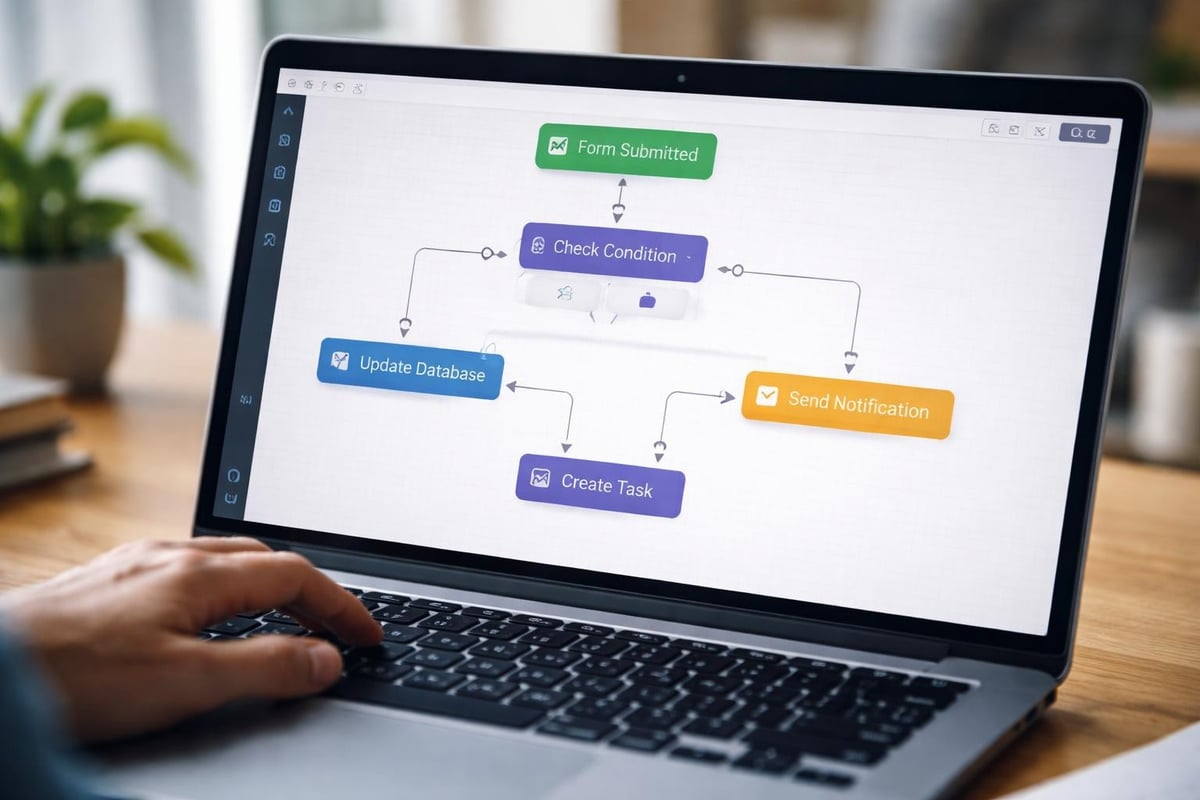
Visual development interfaces form the foundation of every no code app maker. These environments translate visual actions into functional code behind the scenes, allowing users to focus on business logic rather than syntax.
- Drag-and-drop interface builders for creating responsive layouts
- Visual workflow designers for defining application logic
- Database schema builders for structuring information architecture
- Integration marketplaces for connecting external services
- Template libraries for accelerating common use cases
The sophistication of these components determines the platform's capabilities and limitations. Premium platforms provide granular control over styling, complex conditional logic, and advanced data relationships, whilst simpler tools focus on speed and ease of use at the expense of customisation.
Selecting the Right Platform for Your Requirements
Not all platforms serve the same purpose. The ideal no code app maker depends on your specific application type, scalability requirements, and technical complexity. Understanding what no-code mobile app builders offer helps clarify which features matter most for your project.
| Platform Type | Best For | Limitations |
|---|---|---|
| Web App Builders | SaaS products, internal tools, marketplaces | Native mobile app features |
| Mobile-First Platforms | Consumer apps, mobile experiences | Complex web functionality |
| Database-Centric Tools | CRM systems, project management, workflow automation | Custom algorithms |
| E-commerce Builders | Online shops, subscription services | Highly custom business models |
Bubble.io stands out amongst web application platforms for its exceptional balance of power and usability. The platform enables founders to build sophisticated MVPs with complex logic flows, custom user experiences, and scalable architecture. When working with specialists who understand the platform's capabilities, startups can build proof-of-concepts that attract investment without the overhead of traditional development.
Matching Features to Business Needs
Different business models demand different platform capabilities. Understanding your core requirements prevents costly platform migrations later in your product journey.
E-commerce applications require robust payment processing, inventory management, and order fulfilment workflows. Platforms integrated with Shopify ecosystems prove particularly valuable here. The community at Talk Shop offers invaluable insights for merchants building custom e-commerce experiences, connecting Shopify users with practical knowledge about conversion optimization and scaling strategies.
SaaS products demand user authentication, subscription management, role-based permissions, and data isolation between customers. The complexity of SaaS app development often pushes founders toward more sophisticated platforms capable of handling multi-tenant architectures.
Marketplace platforms need dual-sided user experiences, transaction management, rating systems, and trust mechanisms. These requirements typically exceed the capabilities of simple no code tools.
Building Your MVP Without Code
The minimum viable product approach aligns perfectly with no code development philosophy. Both prioritise speed to market, validated learning, and resource efficiency. A no code app maker enables founders to test hypotheses with real users before committing to expensive custom development.
Planning Before Building
Strategic planning accelerates no code development despite the platforms' inherent speed. Successful founders invest time defining user flows, data structures, and core feature sets before touching the builder interface.
- Map user journeys for each persona interacting with your application
- Define your data model including entities, relationships, and key fields
- Prioritise features using MoSCoW (Must have, Should have, Could have, Won't have)
- Design information architecture determining how users navigate your application
- Sketch interface mockups providing visual targets for the build phase
This preparatory work prevents costly rebuilds and ensures your application solves actual user problems. Many founders skip directly to building, discovering fundamental architectural issues only after significant development time.
When transforming agency IP into productised SaaS, this planning phase proves even more critical. Service-based offerings require careful translation into self-service workflows that maintain value whilst removing manual intervention.
Development Best Practices
Even without coding, application development demands disciplined practices. Structure and organisation prevent technical debt that hampers future development.
Consistent naming conventions keep databases and workflows comprehensible. Use descriptive names for data types, fields, and reusable elements rather than generic labels. This discipline proves invaluable when revisiting logic flows months later or when collaborating with team members.
Modular design patterns break complex functionality into reusable components. Creating custom elements for repeated interface patterns maintains consistency and simplifies updates. When you modify a reusable element, every instance updates automatically across your application.
Version control through documentation compensates for the absence of code repositories. Maintain changelogs documenting feature additions, bug fixes, and architectural decisions. Some platforms offer built-in version control, but supplementing this with external documentation provides additional safety.

Overcoming Common Limitations
Despite their power, no code platforms impose certain constraints that founders must understand and navigate. Awareness of these limitations prevents architectural mistakes that become expensive to correct.
Performance and Scalability Considerations
Applications built on no code platforms share resources with other users, potentially creating performance bottlenecks under heavy load. Platform-specific optimizations mitigate many concerns, but understanding capacity limits remains essential.
- Database query optimization prevents slow page loads
- Conditional rendering reduces unnecessary element loading
- External API rate limits require strategic caching approaches
- File storage management impacts application performance
- Workflow efficiency directly affects server resource consumption
Most platforms offer tiered pricing with enhanced performance at higher levels. Planning for scale from the outset prevents emergency upgrades when user numbers spike unexpectedly.
Integration and Customization Boundaries
While modern platforms connect with hundreds of services through APIs, highly specialized integrations may require custom coding. The Zapier review of top no-code app builders highlights integration capabilities as a critical evaluation criterion.
Some platforms allow custom code injection for scenarios beyond native capabilities. This hybrid approach preserves the speed advantages of no code development whilst accommodating unique requirements. However, custom code introduces maintenance overhead and potential platform dependency issues.
API-first architecture provides the greatest flexibility. Building your application to expose and consume APIs enables future migration paths and integration possibilities beyond the platform's native offerings.
Accelerating Time to Market
Speed represents the primary advantage of using a no code app maker. Traditional development cycles spanning months compress into weeks or even days, enabling rapid market testing and iteration.
Rapid Prototyping Strategies
Interactive prototypes validate assumptions before full development commitment. No code platforms enable functional prototypes rather than static mockups, providing authentic user testing experiences.
Limited feature sets keep initial prototypes manageable. Resist feature creep during the prototype phase, focusing exclusively on core value propositions. Users provide more meaningful feedback when evaluating focused functionality rather than scattered features.
Real data testing separates no code prototypes from traditional mockups. Populate databases with realistic content, enabling users to interact with genuine workflows rather than Lorem Ipsum placeholders. This authenticity surfaces usability issues invisible in static designs.
For entrepreneurs seeking to validate business concepts quickly, working with specialists experienced in MVP development accelerates the journey from idea to market-ready product. Expert guidance prevents common pitfalls whilst leveraging platform capabilities most founders overlook.
Iterative Development Cycles
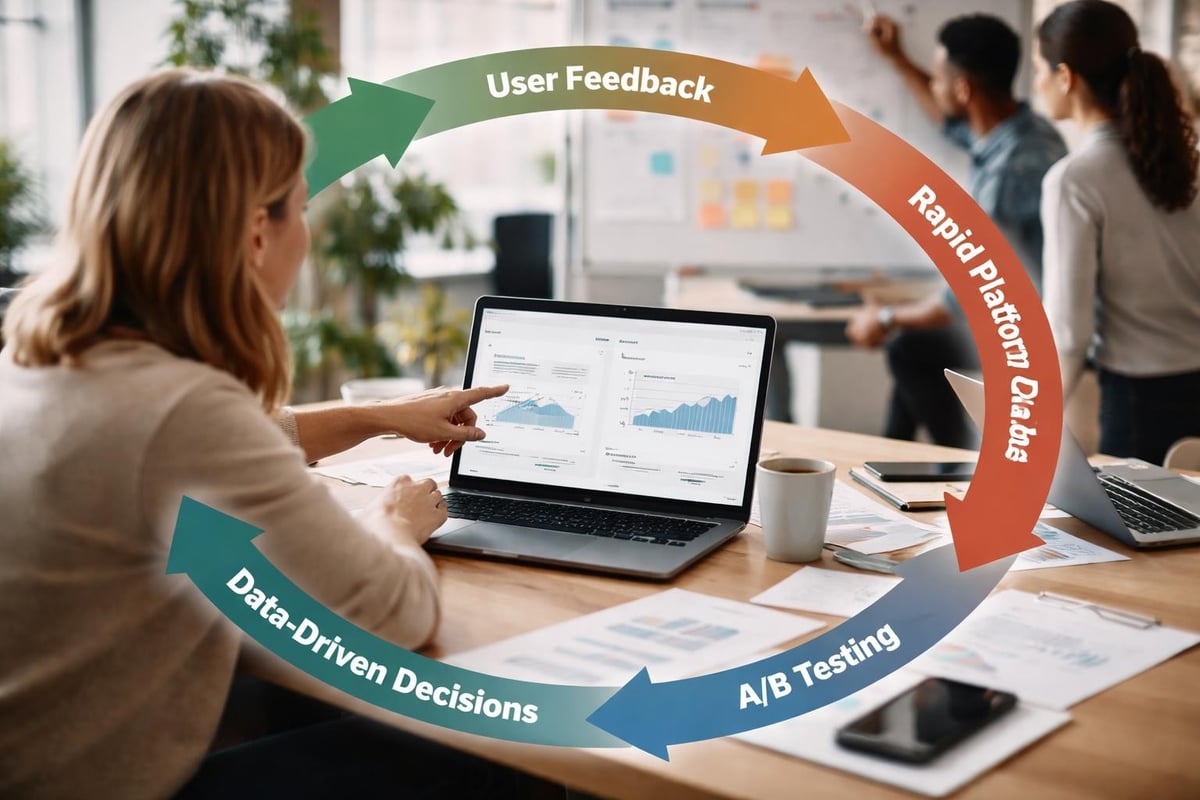
No code platforms excel at iteration. Making changes requires visual adjustments rather than code refactoring, enabling responsive adaptation to user feedback.
| Development Stage | Timeline | Key Activities |
|---|---|---|
| Prototype | 1-2 weeks | Core flows, basic design, essential features |
| Alpha | 2-3 weeks | Expanded features, initial integrations, internal testing |
| Beta | 3-4 weeks | Refinement based on user feedback, performance optimization |
| Launch | 1 week | Final polish, documentation, deployment |
This condensed timeline assumes focused scope and clear requirements. Complex applications with extensive feature sets naturally require longer development periods, but even sophisticated platforms launch faster than traditionally coded equivalents.
Cost Implications and ROI
Financial considerations extend beyond platform subscription fees. A comprehensive view of no code economics reveals significant advantages for startups operating with constrained budgets.
Development Cost Comparison
Traditional custom development requires hiring developers or contracting agencies. Current market rates for competent developers range from £50,000 to £90,000 annually for in-house talent, or £400 to £800 daily for freelancers. A moderately complex application might consume 2-3 months of development time, translating to £20,000-£50,000 in labour costs alone.
No code platforms reverse this equation. Monthly subscriptions typically range from £25 for basic plans to £500 for enterprise features. Even accounting for learning curves and development time, the total cost for a functional MVP rarely exceeds £5,000 when building internally.
Opportunity cost provides another dimension to this analysis. Six months spent developing a traditionally coded application delays revenue generation, user feedback, and competitive positioning. No code development compresses this timeline, bringing forward the moment when your product generates returns.
Hidden Costs to Consider
Platform lock-in represents the primary long-term risk. Applications built on proprietary platforms face significant migration challenges if requirements eventually exceed platform capabilities or if the vendor discontinues services.
- Subscription increases as you scale can dramatically impact unit economics
- Plugin dependencies introduce ongoing costs for premium integrations
- Custom development eventually needed for highly specific features
- Learning investment in platform-specific knowledge rather than transferable skills
- Data migration complexity if platform switching becomes necessary
These considerations shouldn't deter no code adoption but rather inform realistic financial projections. For most startups, the speed and capital efficiency advantages vastly outweigh potential future migration costs.
Talent and Team Considerations
Building without code doesn't eliminate the need for skilled team members. While technical barriers lower dramatically, successful applications still require product thinking, user experience design, and strategic technical decisions.
Building In-House Capabilities
Forward-thinking founders invest in no code literacy across their teams. Product managers who understand platform constraints make better feature prioritization decisions. Designers who grasp technical possibilities create more implementable interfaces.
Platform-specific training accelerates team productivity. Most major platforms offer certification programmes, documentation libraries, and video tutorials. Guides on choosing the right app builder help teams evaluate options before committing training resources.
Cross-functional collaboration increases when non-technical team members contribute directly to product development. Marketing professionals can build landing pages, customer success teams can create support portals, and operations staff can construct internal tools without bottlenecking on engineering resources.
For AI-powered products requiring specialized technical expertise, platforms like Augmnt connect startups with verified AI professionals who can complement no code development with strategic technical guidance and advanced integrations.
When to Hire Specialists
Despite accessibility, complex applications benefit from experienced no code developers who understand advanced patterns, optimization techniques, and platform limitations. Specialists deliver solutions 3-4 times faster than founders learning whilst building.
Architecture decisions in the early stages determine long-term maintainability and scalability. Expert input during database design and workflow structure prevents technical debt accumulation that eventually necessitates complete rebuilds.
Custom integrations often require technical knowledge beyond platform basics. Connecting APIs, handling authentication flows, and managing data transformations benefit from developer experience even within no code environments.
Security and Compliance Requirements
Data protection regulations and security best practices apply equally to no code applications. Platform selection should consider built-in security features and compliance certifications relevant to your industry and geography.
Data Protection Fundamentals
GDPR compliance remains mandatory for applications serving European users. Key requirements include user consent management, data export capabilities, deletion mechanisms, and transparent privacy policies. According to analysis of no-code app builders, reputable platforms provide GDPR-compliant infrastructure, but application-level implementation remains the builder's responsibility.
User authentication security determines access control effectiveness. Multi-factor authentication, password complexity requirements, and session management protect user accounts from unauthorized access. Premium platforms offer enterprise-grade authentication options including single sign-on and OAuth integrations.
Data encryption protects information both in transit and at rest. Verify that chosen platforms encrypt database contents and use HTTPS for all communications. Payment processing should leverage certified providers rather than handling card details directly.
Industry-Specific Compliance
Healthcare applications must satisfy HIPAA requirements governing protected health information. Financial services applications face FCA regulations in the United Kingdom. Educational platforms serving children require additional safeguards under various child protection frameworks.
Not all platforms provide compliance certifications for regulated industries. Research requirements thoroughly before committing to a platform if operating in regulated sectors. Some scenarios genuinely require traditional development approaches with appropriate compliance infrastructure.
Future-Proofing Your Application
Technology choices made today determine flexibility tomorrow. Strategic decisions during initial development preserve options as your business evolves and requirements expand.
Platform Evolution Considerations
The no code landscape evolves rapidly, with platforms adding capabilities quarterly. Current assessments of the best no-code app builders become outdated within months as vendors release new features and integrations.
Selecting platforms with strong development roadmaps and active communities reduces obsolescence risk. Established vendors with significant user bases demonstrate commitment through continuous improvement. Community forums, plugin marketplaces, and third-party resources indicate ecosystem health.
Vendor stability matters tremendously given platform lock-in realities. Evaluate funding status, customer base size, and market positioning. Well-capitalized vendors with sustainable business models provide greater continuity assurance than underfunded startups in crowded markets.
Transition Strategies
Planning for eventual migration acknowledges that startup needs evolve. Applications proving product-market fit eventually justify custom development investment for competitive differentiation and capability expansion.
API-centric design facilitates gradual migration. Building your application to expose functionality through APIs enables replacing individual components with custom code whilst maintaining the broader no code infrastructure.
Data portability preserves your most valuable asset. Ensure chosen platforms support comprehensive data exports in standard formats. Regular backups prevent catastrophic data loss scenarios and enable migration dry runs.
Hybrid approaches combine no code speed with custom development where it matters most. Use platforms for standard functionality whilst developing proprietary algorithms or unique features in traditional code. This strategy optimizes development resources whilst preserving competitive advantages.
Measuring Success and Optimization
Launching represents the beginning rather than the end of product development. Continuous measurement and optimization transform initial MVPs into refined products that genuinely serve user needs.
Analytics Integration
Understanding user behaviour requires robust analytics implementation. Most platforms integrate with Google Analytics, Mixpanel, or Amplitude, enabling detailed usage tracking without custom code.
Event tracking reveals how users interact with specific features. Monitor button clicks, page transitions, form submissions, and workflow completions to identify friction points and popular functionality.
Conversion funnel analysis pinpoints where users abandon key processes. Registration flows, checkout sequences, and onboarding paths all benefit from conversion optimization based on actual user behaviour data.
Cohort analysis segments users by acquisition date, enabling assessment of how product changes impact different user groups. This longitudinal view reveals whether iterations improve or degrade user experience.
Performance Monitoring
Application speed directly impacts user satisfaction and conversion rates. Research consistently shows users abandon applications that respond slowly or exhibit unreliable behaviour.
- Page load times should remain under 3 seconds for optimal user experience
- Database query performance requires monitoring and optimization as data volume grows
- API response times impact perceived application responsiveness
- Error rates indicate stability issues requiring immediate attention
- Uptime monitoring ensures rapid response to outages or degraded performance
Platform-provided monitoring dashboards offer basic insights, but serious applications benefit from dedicated monitoring services that provide alerts, historical trends, and diagnostic tools.
The transformation in application development created by no code platforms has fundamentally changed what's possible for startups with limited technical resources and tight timeframes. Strategic platform selection, disciplined development practices, and realistic awareness of both capabilities and constraints enable founders to build sophisticated applications that validate business models and serve real user needs. Whether you're an entrepreneur with a vision or a startup seeking to test hypotheses quickly, Creator Concepts brings award-winning expertise in Bubble.io development to transform your ideas into market-ready MVPs in weeks rather than months.