

The United Kingdom represents one of Europe's most mature and competitive mobile application markets. Building an app in UK territory requires understanding not just technical development, but the unique characteristics of British consumers, regulatory requirements, and market dynamics that differentiate this landscape from other regions. With smartphone penetration exceeding 90% and UK consumers spending increasingly more time on mobile apps, entrepreneurs and startups face both tremendous opportunity and significant challenges when entering this space.
The British mobile application ecosystem has evolved dramatically over the past decade. Today's app in UK markets must compete in an environment where users have become sophisticated, selective, and demanding about the experiences they choose to engage with daily.
Market research reveals fascinating patterns about how British consumers interact with mobile applications. According to Statista's comprehensive mobile app usage data, the average UK smartphone user maintains between 40-50 apps on their device but regularly uses only about 9-10 of these applications. This concentration of attention means breaking into users' daily routines requires exceptional value proposition and execution.
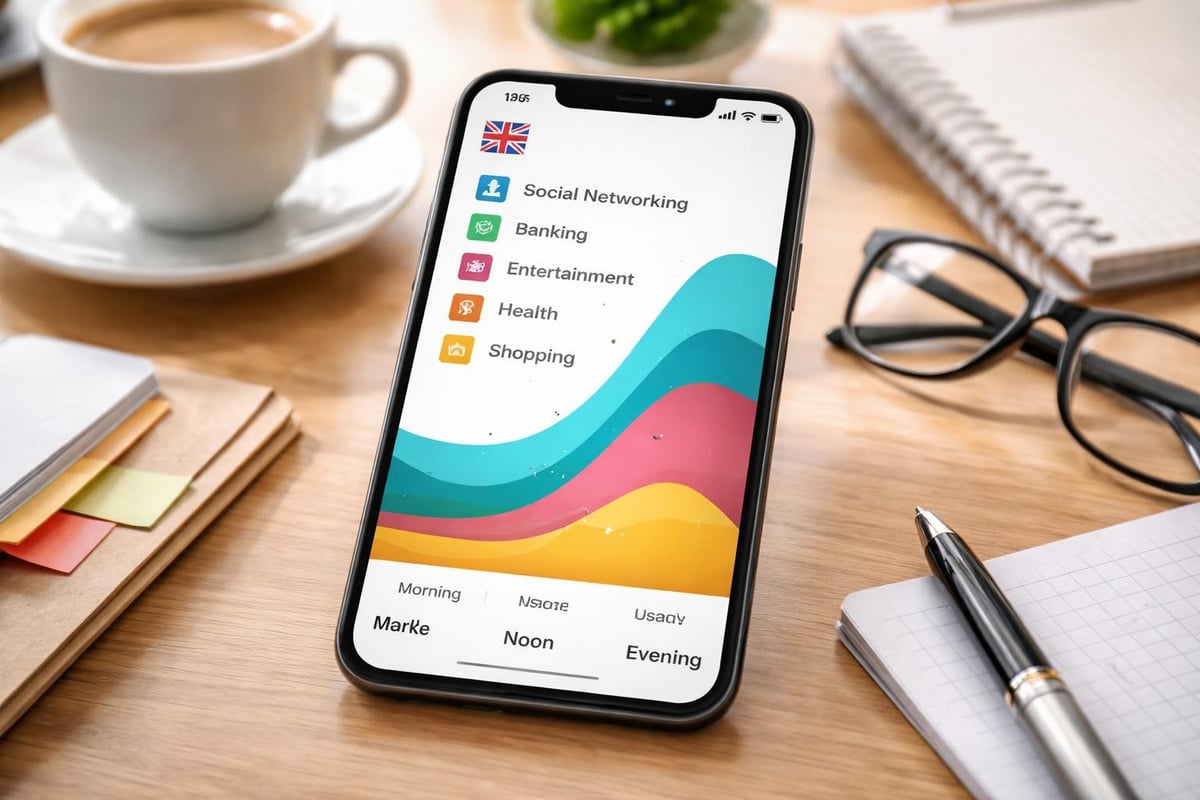
Different app categories command varying levels of user attention and loyalty. Understanding which smartphone app types see the most usage in the UK provides crucial insights for positioning your offering.
The following categories consistently demonstrate strong engagement:
Beyond these dominant categories, niche applications serving specific professional or lifestyle needs continue to find sustainable audiences. The key differentiator often lies not in the category itself but in execution quality, user experience design, and ongoing value delivery.
When developing an app in UK territory, founders face critical decisions about development methodology, technology stack, and launch strategy. These choices significantly impact both time-to-market and long-term scalability.
Traditional native development for iOS and Android offers maximum performance and platform-specific features but requires separate codebases and specialized development teams. This approach typically demands 4-6 months for initial development and budgets exceeding £50,000 for even straightforward applications.
Cross-platform frameworks like React Native or Flutter provide code reusability across iOS and Android, reducing development time by approximately 30-40%. However, accessing platform-specific features still requires native coding expertise, and performance can lag behind fully native implementations for graphics-intensive applications.
No-code development platforms have transformed how entrepreneurs approach application development. These tools enable rapid prototyping and MVP development without traditional programming knowledge, allowing founders to validate concepts before committing significant capital.
For startups building an app in UK markets, this approach offers distinct advantages:
The strategic question isn't whether no-code tools can build production-ready applications-numerous successful companies have proven they can. Rather, founders must assess whether their specific use case aligns with these platforms' capabilities or requires custom native development.
Operating an app in UK jurisdictions requires navigating a complex regulatory environment that has grown increasingly stringent regarding data protection, consumer rights, and digital services.
The UK maintains GDPR-equivalent data protection standards through the Data Protection Act 2018 and UK GDPR. Applications collecting personal data must implement robust consent mechanisms, clear privacy policies, and technical safeguards for data storage and processing.
Key compliance requirements include:
| Requirement | Implementation Detail | Enforcement Risk |
|---|---|---|
| Lawful basis for processing | Documented legitimate interest or explicit consent | Fines up to £17.5M or 4% turnover |
| Right to erasure | Systematic data deletion within 30 days of request | Regulatory orders and penalties |
| Data breach notification | ICO notification within 72 hours | Reputational damage and fines |
| Privacy by design | Default settings minimize data collection | Compliance audits |
Beyond GDPR, sector-specific regulations apply to applications in financial services, healthcare, and children's services. Any app in UK markets targeting users under 18 must comply with the Age Appropriate Design Code, which imposes additional protections for minors' data and online experiences.

Building exceptional functionality represents only half the challenge. Acquiring users in the competitive UK app landscape requires strategic marketing that acknowledges British consumers' preferences and behaviours.
Research on top mobile apps UK users download reveals that discovery happens through multiple channels, with organic search, social media, and word-of-mouth referrals all playing significant roles.
Paid user acquisition costs in the UK vary dramatically by category and competition intensity. Finance, gambling, and subscription service apps face the highest acquisition costs, often exceeding £15-25 per install for qualified users. Utility, productivity, and niche community applications typically see lower costs in the £2-8 range.
Apple Search Ads deliver strong performance for iOS acquisition, particularly for applications with clear search intent. Conversion rates typically range between 15-30% for well-optimized campaigns targeting relevant keywords.
Facebook and Instagram advertising enable sophisticated demographic and interest-based targeting. Creative testing proves essential, as British audiences respond differently to various messaging angles and visual styles compared to other markets.
TikTok advertising has emerged as particularly effective for reaching users under 35, though creative requirements differ substantially from traditional platforms. Authentic, entertaining content outperforms polished advertising creative.
Sustainable growth for an app in UK markets increasingly relies on organic channels that don't scale linearly with advertising spend.
App Store Optimization (ASO) serves as the foundation for organic discovery. British users tend to read reviews extensively before downloading, making review generation and management critical. Localization matters-using British English spelling and culturally relevant examples improves conversion rates measurably.
Content marketing drives awareness and trust before users even reach app stores. Educational content addressing problems your application solves builds authority and search visibility. Understanding how to structure development processes can help communicate your expertise to potential users.
Referral programmes leverage existing users to drive new installs, though success requires careful incentive design. British consumers respond better to mutual benefit structures than purely selfish referral rewards.
Revenue generation strategies for an app in UK territory must account for British consumers' willingness to pay, which varies considerably across categories and value propositions.
The UK market demonstrates several distinct pricing behaviours:
British consumers have become accustomed to subscription services through Netflix, Spotify, and Amazon Prime. However, subscription fatigue has set in, making value demonstration critical.
Successful subscription apps in UK markets typically offer:
Price sensitivity varies significantly across demographics and regions within the UK. London-based users demonstrate higher willingness to pay for convenience and premium features compared to users in other regions, though this gap has narrowed slightly in recent years.
Measuring success for an app in UK markets requires tracking metrics beyond vanity numbers like total downloads. Actionable analytics focus on user behaviour, engagement quality, and economic viability.
| Metric Category | Key Indicators | UK Benchmarks |
|---|---|---|
| Acquisition | Cost per install (CPI), organic vs paid ratio | £2-25 depending on category |
| Activation | Day 1 retention, onboarding completion | 25-40% D1 retention |
| Engagement | Daily/monthly active users, session duration | 20-30% DAU/MAU ratio |
| Retention | D7, D30, D90 retention curves | D30: 10-15% typical |
| Revenue | ARPU, LTV, LTV:CAC ratio | 3:1 minimum LTV:CAC |
Understanding these benchmarks helps founders set realistic expectations and identify performance gaps requiring attention. An app in UK markets with Day 1 retention below 20% likely suffers from onboarding friction or misaligned user expectations set during acquisition.
Cohort analysis proves particularly valuable for understanding how user behaviour evolves over time and whether product improvements genuinely impact retention. Comparing cohorts month-over-month reveals whether you're building a healthier user base or simply growing a leaky bucket.
Applications serving UK users must deliver reliable, fast experiences that meet elevated expectations set by established platforms. Technical architecture decisions made during initial development significantly impact your ability to scale.
While cloud infrastructure has globalized, hosting location impacts both latency and regulatory compliance. Major cloud providers offer UK-specific regions (London data centers) that deliver optimal performance for British users while simplifying GDPR compliance through data residency.
Response times matter enormously to user experience. Research consistently shows that load times exceeding 2 seconds increase abandonment rates substantially. For applications serving UK users, CDN implementation and database query optimization prove essential for maintaining performance as user bases grow.

Both iOS and Android ecosystems offer platform-specific capabilities that can differentiate your app in UK markets when implemented thoughtfully.
Apple's ecosystem provides several distinctive opportunities. App Clips enable lightweight experiences without full installation, reducing friction for first-time engagement. Sign in with Apple offers privacy-focused authentication that resonates with security-conscious British users. Widgets provide persistent visibility on home screens, increasing engagement frequency.
Android's platform offers different strengths. Deep integration with Google services enables powerful location-based features and calendar integration. File system access supports use cases requiring document management. Device diversity, while challenging for testing, allows reaching users across broader price points than iOS's premium-focused market.
Push notification strategies must adapt to platform differences and user preferences. British consumers demonstrate growing notification fatigue, making relevance and personalization critical. Generic promotional notifications see open rates below 5%, while personalized, timely notifications can achieve 25-40% engagement.
The application landscape continues evolving rapidly, with several trends particularly relevant for anyone building an app in UK markets during 2026 and beyond.
Artificial intelligence integration has moved from novelty to expectation. AI usage statistics show growing UK adoption of intelligent features, from personalized recommendations to natural language interfaces. Applications lacking smart automation increasingly feel outdated compared to AI-enhanced alternatives.
Progressive Web Apps (PWAs) blur boundaries between web and native experiences. For certain use cases, PWAs offer installation-free access, automatic updates, and cross-platform consistency that challenge traditional app development assumptions. British users' comfort with web-based services makes PWAs particularly viable for content and service-oriented applications.
Super app ecosystems haven't achieved the same dominance in the UK as in Asian markets, but bundled functionality within single applications continues trending upward. Users prefer platforms offering multiple related services over managing numerous specialized applications.
Privacy-first architecture has shifted from differentiator to requirement. British consumers increasingly scrutinize data practices, making transparent, minimal data collection a competitive advantage rather than merely a compliance obligation.
Voice interfaces and conversational UI patterns continue gaining traction, particularly for utility and accessibility applications. Integration with Alexa, Google Assistant, and Siri extends application touchpoints beyond screens.
Applications incorporating social elements consistently demonstrate superior retention and engagement metrics compared to purely transactional or utility-focused apps. Building community within your app in UK markets creates network effects that improve defensibility and reduce acquisition costs over time.
Effective social features align with your core value proposition rather than feeling bolted on. Fitness applications benefit from challenge systems and achievement sharing. Productivity tools gain from team collaboration features. Understanding tools for community app development helps implement these features effectively.
British users tend toward reserved engagement patterns compared to some markets. Public sharing features see lower adoption than private or small-group interactions. Design social features acknowledging this cultural preference for measured participation over enthusiastic broadcasting.
Moderation requirements increase substantially when introducing user-generated content. The Online Safety Act 2023 places legal obligations on platforms hosting user content, making moderation systems essential from launch rather than something to address later.
Applications launching in UK markets face sophisticated users with high quality expectations shaped by world-class digital services. Comprehensive testing across devices, operating system versions, and usage scenarios proves essential.
Beta testing with real UK users uncovers issues that internal testing misses. TestFlight for iOS and Google Play's internal testing tracks enable controlled rollouts gathering feedback before public launch. British beta testers typically provide detailed, actionable feedback when properly engaged.
Accessibility testing ensures your application serves the full spectrum of UK users, including those with disabilities. Beyond legal compliance under the Equality Act 2010, accessible design often improves usability for all users. Screen reader compatibility, sufficient colour contrast, and keyboard navigation support should be tested systematically.
Performance testing under various network conditions matters particularly for applications used during commutes and travel. Mobile internet usage patterns in the UK show significant mobile data consumption, but connectivity quality varies considerably across locations and carriers.
Successfully introducing an app in UK markets requires coordinated execution across product readiness, marketing preparation, and operational capability to support initial users.
Soft launches in limited geographic regions allow testing acquisition channels and onboarding flows before national rollout. Starting in specific UK cities provides manageable user volumes while generating real usage data informing broader launch decisions.
Press and influencer outreach proves more effective when timed around specific milestones or newsworthy angles. British technology media receives countless pitches daily, making compelling narratives essential for coverage. Problem-solution framing resonates more strongly than feature lists.
App store featuring represents the holy grail of free visibility but requires exceptional execution, unique positioning, or timely relevance to current events. Building relationships with Apple and Google editorial teams through quality submissions increases featuring probability over time.
Launch timing considerations include avoiding major holidays when users are less engaged with new applications, while capitalizing on New Year motivation peaks or back-to-school seasons depending on your category.
Building a successful app in UK markets demands understanding technical development, regulatory compliance, user psychology, and market dynamics simultaneously. The most successful applications balance sophisticated functionality with intuitive experiences whilst respecting British consumers' privacy expectations and quality standards. Whether you're validating an initial concept or scaling an established platform, partnering with experienced development teams accelerates your path to market. Creator Concepts specializes in helping entrepreneurs and startups build award-winning MVPs using no-code platforms, transforming ideas into market-ready applications in weeks rather than months.
© 2026 CreatorConcepts Limited
128 City Road, London EC1V 2NX