

The digital transformation landscape has fundamentally changed how entrepreneurs and startups bring their ideas to market. Traditional software development once required extensive coding knowledge, substantial budgets, and months of development time. Today, platforms like Bubble no code have democratised application development, enabling founders to build sophisticated web applications through visual interfaces rather than programming languages. This shift represents more than just a technological advancement-it's a fundamental reimagining of who can create digital products and how quickly they can validate their business ideas.
Bubble no code stands as one of the most powerful visual programming platforms available to modern entrepreneurs. Unlike simple website builders, this platform enables users to create fully functional web applications with complex databases, user authentication, payment processing, and intricate workflows-all without writing a single line of traditional code.
The platform operates on a visual canvas where developers drag and drop elements, define workflows through logic trees, and structure databases through intuitive interfaces. This approach removes the technical barrier that historically prevented non-technical founders from bringing their visions to life. However, calling it "simple" would be misleading. Bubble's capabilities rival those of traditional coded applications, supporting complex business logic and scalable architectures.
Every Bubble application consists of several fundamental building blocks that work together seamlessly:
The visual editor presents these components in an organised workspace where creators can see exactly how their application will function. Unlike traditional development environments that require constant compilation and testing, Bubble provides immediate visual feedback. Changes appear instantly, allowing rapid iteration and experimentation.
Speed to market remains the critical factor for startup success. The longer an idea remains unvalidated, the greater the risk of market changes, competitor movements, or resource depletion. Bubble no code addresses this challenge directly by compressing development timelines from months to weeks.
Traditional MVP development requires assembling a technical team, establishing infrastructure, writing thousands of lines of code, and conducting extensive testing. Each stage introduces delays and costs. Bubble condenses this process by providing pre-built functionality that addresses common requirements. Authentication systems, payment processing, file storage, and responsive design all exist as configurable features rather than custom development tasks.
For founders working with agencies like those specialising in MVP development, the Bubble platform enables collaborative building where business logic and technical implementation happen simultaneously. Non-technical founders can participate directly in the development process, adjusting features and workflows based on real-time feedback rather than waiting for development sprints to complete.
| Cost Factor | Traditional Development | Bubble No Code |
|---|---|---|
| Initial Development | £25,000-£75,000 | £5,000-£20,000 |
| Time to Launch | 3-6 months | 2-6 weeks |
| Minimum Team Size | 2-4 developers | 1 Bubble developer |
| Infrastructure Setup | Complex, expensive | Included, managed |
| Iteration Speed | Weeks per change | Hours to days |
These financial advantages prove particularly valuable during the validation phase. Startups can allocate resources to customer acquisition and market testing rather than sinking capital into unproven technology. When pivots become necessary-as they often do-rebuilding functionality in Bubble requires significantly less investment than rewriting coded applications.
A common misconception suggests that bubble no code platforms suit only simple projects. This assumption underestimates the platform's architectural capabilities. Modern no-code development platforms have evolved to support enterprise-level complexity whilst maintaining accessibility.
Bubble applications can manage thousands of users, process complex calculations, integrate with external APIs, and handle sophisticated permission systems. The platform supports custom states for managing temporary data, option sets for maintaining consistent values, and privacy rules that enforce data security at the database level. These features enable developers to build applications matching the functionality of traditionally coded solutions.
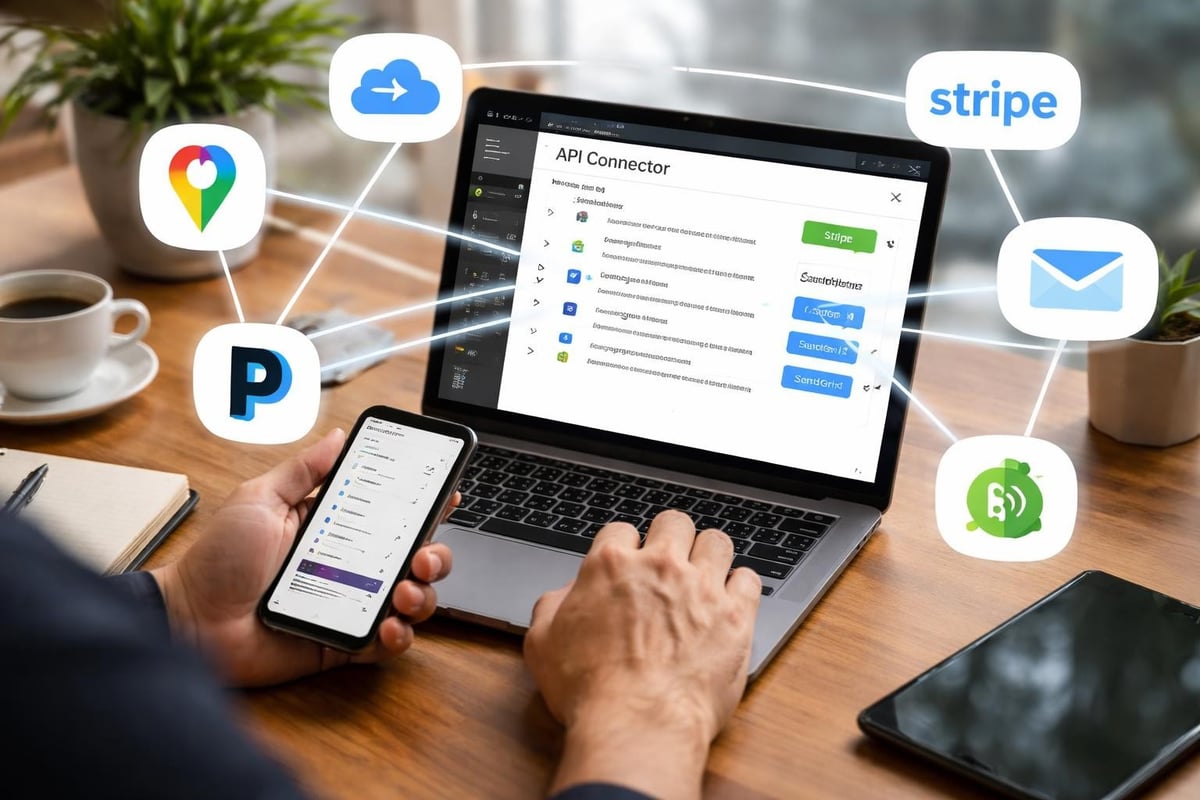
The platform's plugin ecosystem extends its capabilities beyond the core offering. Developers can integrate payment processors like Stripe, communication tools including Twilio, mapping services, AI capabilities, and countless other third-party services. When pre-built plugins don't meet specific needs, Bubble's API Connector allows custom integrations with virtually any external service offering an API.
Conditional formatting enables dynamic user interfaces that adapt based on user behaviour, device type, or data states. Recursive workflows handle batch processing and scheduled tasks. Server-side actions protect sensitive operations from client-side manipulation. These advanced features demonstrate how bubble no code transcends the limitations typically associated with visual development platforms.
Proper database architecture forms the foundation of any scalable application. Bubble approaches database design through a visual interface that makes relationships and structures immediately comprehensible. Data types represent tables, fields define the attributes each record contains, and privacy rules determine access permissions.
The platform supports various field types including text, numbers, dates, geographic coordinates, images, files, and relationships to other data types. One-to-many and many-to-many relationships connect data logically, mirroring the relational database concepts used in traditional development. This structure ensures applications can grow without requiring fundamental architectural changes.
Privacy rules operate at the database level, ensuring data security regardless of how users attempt to access information. These rules define which users can view, modify, or delete specific records based on conditions like ownership, role, or custom logic. This server-side enforcement provides security comparable to traditionally coded applications.

Modern users expect applications to function seamlessly across devices. Bubble no code addresses this requirement through built-in responsive design capabilities that adapt layouts automatically. Developers define how elements behave at different screen widths, ensuring optimal experiences on desktops, tablets, and mobile devices.
The platform offers several approaches to responsive design:
These responsive features ensure applications deliver professional experiences regardless of how users access them. Learning to build responsive Bubble applications represents an essential skill for anyone serious about no-code development.
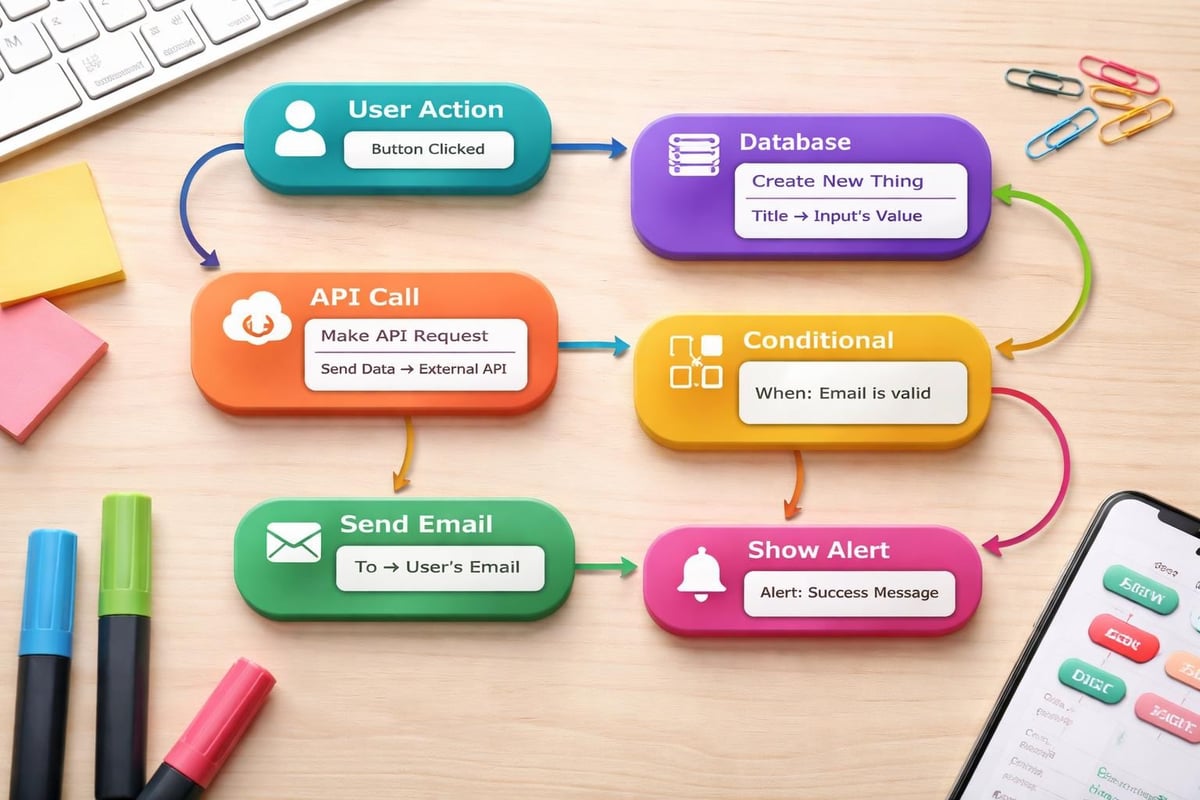
Workflows define what happens when users interact with your application. In Bubble, workflows consist of events (what triggers the workflow) and actions (what happens as a result). This event-action model mirrors traditional programming logic whilst remaining visually comprehensible.
Common workflow triggers include button clicks, page loads, data changes, scheduled intervals, or custom events. Actions might create database entries, navigate to different pages, send emails, call APIs, or modify element properties. Multiple actions can chain together, creating complex sequences that execute in order.
Conditional statements add sophistication by executing actions only when specific criteria are met. A workflow might send a welcome email only to users who haven't received one previously, or display error messages only when form validation fails. These conditions use Bubble's expression system, which allows comparisons, calculations, and logical operations.
Custom states manage temporary data that doesn't need database storage. States track interface conditions like whether a popup is visible, which filter is active, or what data a user is currently viewing. This client-side data management keeps applications responsive whilst minimising database queries.
The combination of workflows, conditions, and states enables developers to create applications with behaviour rivalling traditionally coded solutions. Complex user journeys, multi-step processes, and dynamic interfaces all become achievable without programming knowledge.
No application exists in isolation. Modern web applications must connect with payment processors, email services, analytics platforms, and countless other tools. Bubble no code facilitates these integrations through plugins and the API Connector.
Pre-built plugins cover common integration needs including Stripe for payments, SendGrid for emails, Google Maps for location services, and numerous others. These plugins provide ready-made actions and data sources that developers can incorporate into their applications immediately.
The API Connector handles custom integrations with any service offering an API. Developers configure API calls through a visual interface, defining endpoints, authentication methods, parameters, and response handling. Once configured, API data becomes available throughout the application like any other data source.
| Integration Type | Implementation Method | Complexity Level |
|---|---|---|
| Payment Processing | Pre-built Plugins | Low |
| Email Services | Pre-built Plugins | Low |
| Custom APIs | API Connector | Medium |
| Authentication | Built-in + Plugins | Low to Medium |
| File Storage | Built-in + Plugins | Low |
| Analytics | Pre-built Plugins | Low |
These integration capabilities ensure bubble no code applications can participate fully in the modern digital ecosystem. Whether connecting to CRM systems, social media platforms, or proprietary internal tools, Bubble provides pathways for data exchange and functionality extension.
As applications grow, performance becomes increasingly critical. Bubble addresses scalability through several architectural decisions and best practices. Understanding these considerations helps developers build applications that maintain responsiveness as user bases expand.
Database queries represent the primary performance consideration. Well-structured searches with appropriate constraints return results quickly. Poorly designed searches that scan entire databases create slowdowns. Bubble provides tools for optimising queries including database indexes, which improve search speed for frequently queried fields.
The platform operates on shared infrastructure for standard plans, meaning resources are distributed amongst multiple applications. For applications requiring dedicated resources, Bubble offers capacity plans providing guaranteed server capacity. This tiered approach allows startups to begin affordably whilst retaining upgrade paths as they scale.
These optimisation techniques, combined with Bubble's managed infrastructure, enable applications to support thousands of concurrent users. Understanding Bubble's capabilities and limitations helps developers make informed architectural decisions from the outset.
Despite eliminating traditional coding, bubble no code requires learning platform-specific concepts and methodologies. New users face a learning curve as they master the visual interface, understand database design principles, and develop proficiency with workflow logic.
The platform's complexity mirrors the sophistication of applications it enables. Simple projects like landing pages or basic directories can be built within hours. Complex applications with user authentication, payment processing, and intricate business logic require deeper understanding. Most developers achieve basic competency within weeks and develop advanced skills over several months.
Numerous learning resources support skill development. The official Bubble manual provides comprehensive documentation. Community forums connect developers facing similar challenges. Video tutorials demonstrate specific techniques and common patterns. Structured learning paths guide beginners through progressive skill development.
For startups prioritising speed, partnering with experienced agencies accelerates delivery whilst enabling knowledge transfer. Founders learn Bubble concepts alongside development, building capacity for future iterations and maintenance.
Data security remains paramount, particularly for applications handling sensitive user information or financial transactions. Bubble no code implements multiple security layers protecting applications and their data.
All applications run on HTTPS by default, encrypting data transmission between users and servers. The platform maintains SOC 2 Type II certification, demonstrating compliance with rigorous security standards. Regular security audits and penetration testing identify and address potential vulnerabilities.
Database privacy rules enforce access controls at the server level, preventing unauthorised data access regardless of client-side manipulation attempts. These rules define precisely which users can view, modify, or delete specific records based on customisable conditions. This approach ensures security decisions remain under developer control rather than relying solely on platform defaults.
For applications requiring specific compliance standards like GDPR, Bubble provides tools and configurations supporting regulatory requirements:
These features enable bubble no code applications to meet regulatory requirements across jurisdictions. Developers must implement these capabilities appropriately, but the platform provides the necessary foundation.
Quality applications require thorough testing before launch. Bubble supports comprehensive testing through development and staging environments. Changes can be developed and tested separately from the live application, preventing disruptions to active users.
The platform's visual nature simplifies certain testing aspects. Developers can immediately see interface changes without compilation cycles. Workflow testing occurs in real-time, with debug mode revealing exactly which actions execute and in what order. This transparency accelerates issue identification and resolution.
However, systematic testing remains essential. User acceptance testing with representative users identifies usability issues and edge cases. Performance testing under simulated load conditions reveals scalability constraints. Security testing ensures privacy rules and authentication mechanisms function correctly.
Many development teams establish testing checklists covering functionality, performance, security, and user experience. These systematic approaches catch issues before they reach production, ensuring smooth launches and positive user experiences.
Deploying bubble no code applications involves pushing changes from development to production environments. The platform manages infrastructure, server configuration, and deployment mechanics automatically. Developers simply click to deploy, and changes go live within minutes.
Version control capabilities allow reverting to previous application states if deployments introduce issues. This safety net enables confident iteration without fear of irreversible mistakes. Scheduled deployments can occur during low-traffic periods, minimising user disruption.
Post-launch maintenance differs significantly from traditional development. Bubble manages server updates, security patches, and infrastructure scaling automatically. Developers focus on feature additions, bug fixes, and optimisation rather than infrastructure management.
The platform's logs provide visibility into application behaviour, capturing errors, performance metrics, and user actions. These insights inform optimisation priorities and reveal issues requiring attention. Regular monitoring ensures applications continue performing optimally as usage patterns evolve.
Bubble no code has transformed how entrepreneurs and startups approach application development, enabling rapid validation of business ideas without the traditional barriers of coding expertise and extensive budgets. Whether you're building your first MVP or scaling an existing concept, understanding these platform capabilities positions you for success in the modern digital landscape. Creator Concepts specialises in helping founders navigate the Bubble development process, creating award-winning MVPs that validate ideas quickly whilst maintaining the scalability needed for growth.
© 2026 CreatorConcepts Limited
128 City Road, London EC1V 2NX