
Finding the right technical talent to transform your startup idea into a functional product remains one of the most critical decisions for entrepreneurs in 2026. When you decide to hire bubble io developer, you're choosing a path that combines rapid development with cost efficiency, but the process requires careful consideration. The no-code movement has matured significantly, and Bubble.io has emerged as the platform of choice for founders seeking to build sophisticated applications without traditional coding. This guide explores everything you need to know about recruiting skilled Bubble.io developers who can bring your vision to life.
The market for Bubble.io specialists has evolved considerably since the platform's introduction. Today's ecosystem includes freelancers, agencies, and dedicated development teams, each offering distinct advantages for different project types.
Bubble.io developers typically fall into three categories:
When evaluating whether to hire bubble io developer from any of these categories, understanding your project's complexity and timeline proves essential. A simple marketplace application might suit a freelancer perfectly, whilst enterprise-grade solutions often benefit from agency expertise.
The skill levels vary dramatically across the market. Some developers focus primarily on visual design and basic workflows, whilst others possess advanced capabilities in API integrations, database architecture, and performance optimisation. Distinguishing between these proficiency levels early in your hiring process prevents costly mismatches down the line.

Before you hire bubble io developer, establish clear criteria for the technical skills your project demands. Beyond basic Bubble.io proficiency, developers should demonstrate understanding of responsive design principles, database normalisation, and workflow optimisation.
Essential technical areas include:
Advanced developers should also understand security best practices, user authentication systems, and proper data privacy implementation. The official Bubble.io platform's page for hiring developers provides additional insights into these competency areas.
Testing practical abilities matters more than reviewing credentials alone. Request portfolio examples that demonstrate similar complexity to your intended project, and ask specific technical questions about their implementation approaches.
Clarity in project definition directly impacts your success when you hire bubble io developer. Ambiguous requirements lead to scope creep, timeline delays, and budget overruns that could have been avoided through proper planning.
Start by documenting your core features and user workflows. Create wireframes or mockups that illustrate the user interface and experience you envision. This visual reference helps developers understand your expectations and provide accurate estimates.
| Requirement Type | What to Document | Why It Matters |
|---|---|---|
| Functional | User roles, features, workflows | Defines scope and complexity |
| Technical | Integrations, APIs, data sources | Identifies specialised skills needed |
| Design | Branding, UI/UX preferences | Ensures visual alignment |
| Timeline | Launch date, milestone phases | Determines resource allocation |
| Budget | Total investment, payment structure | Narrows candidate pool |
Many founders underestimate the value of MVP development approaches that prioritise core functionality over comprehensive feature sets. This strategy allows you to validate your concept whilst maintaining development efficiency and controlling costs.
Consider your ongoing needs beyond initial launch. Will you require maintenance, feature additions, or scaling support? These factors influence whether to hire bubble io developer on a project basis or establish a longer-term relationship.
Your developer brief serves as the foundation for all subsequent conversations and proposals. Structure it to communicate clearly whilst remaining concise enough for busy professionals to review quickly.
Include sections on:
Transparency about constraints prevents wasted time on both sides. If your budget limits certain options, state this upfront rather than discovering incompatibility after extensive discussions.
Multiple channels exist for finding Bubble.io talent, each with distinct advantages and potential drawbacks. Your choice depends on budget, timeline, and the level of support you require throughout development.
Primary sourcing channels include:
When you hire bubble io developer through platforms offering pre-vetted professionals, you benefit from reduced screening time but often pay premium rates. Direct hiring from community forums may offer cost savings but requires more thorough vetting on your part.
Geographic location affects both cost and communication dynamics. Remote work has normalised global collaboration, but time zone differences can complicate real-time discussions. Evaluate whether synchronous communication matters for your project's success.
Portfolio quality reveals far more than years of experience or client testimonials. Examine actual applications developers have built, testing functionality and assessing code quality where possible.
Look for projects demonstrating:
Request access to live applications rather than relying solely on screenshots. Testing actual functionality uncovers implementation quality that images cannot convey. Understanding whether Bubble is good for SaaS products helps evaluate if portfolio examples align with your product category.

Red flags include portfolios showing only template-based work, absence of custom functionality, or applications with obvious performance issues. Developers should articulate their specific contributions to team projects rather than claiming credit for entire builds they only partially completed.
Structured evaluation separates genuinely skilled developers from those with superficial platform knowledge. When you hire bubble io developer, implementing a multi-stage vetting process protects your investment and timeline.
Begin with practical questions that reveal problem-solving approaches and technical depth:
Strong candidates provide specific examples from previous projects rather than generic theoretical responses. They should demonstrate understanding of trade-offs between different implementation approaches.
Beyond interviews, practical assessments validate claimed expertise. Consider these evaluation approaches:
| Assessment Type | What It Tests | Implementation |
|---|---|---|
| Small paid task | Real-world problem-solving | Define 2-4 hour mini-project |
| Code review | Quality and best practices | Review existing Bubble app structure |
| Technical challenge | Specific skill areas | Present scenario requiring solution design |
| Portfolio walkthrough | Communication and thinking | Have candidate explain their design decisions |
Paid test projects demonstrate commitment whilst respecting developers' time. The investment proves worthwhile when it prevents costly hiring mistakes. Resources like Flexiple's vetting process offer frameworks you can adapt for your own assessment.
Communication skills matter equally to technical abilities. Developers who explain concepts clearly and ask clarifying questions typically deliver better outcomes than those who make assumptions without seeking input.
Costs to hire bubble io developer vary significantly based on experience, location, project complexity, and engagement structure. Understanding typical pricing helps establish realistic budgets and identify suspiciously low quotes that may indicate quality issues.
Common pricing structures include:
UK-based developers and agencies typically charge higher rates than international alternatives, but offer advantages in time zone alignment and potential face-to-face collaboration. For London-based startups, working with local teams like those in Canary Wharf provides proximity benefits for complex projects requiring frequent interaction.
The lowest quote rarely represents the best value. Experienced developers complete work faster and with fewer revisions, often making their higher rates more economical overall.
Consider these value factors beyond base rates:
Platforms like Smartbrain.io's engagement models demonstrate various pricing approaches and their suitability for different project types. Evaluate total project cost rather than focusing solely on hourly rates when making comparisons.
Budget contingency of 15-20% above estimates accommodates scope clarifications and unforeseen complexity. This buffer prevents difficult decisions when critical features prove more involved than initially anticipated.
Successful collaboration requires clear communication, realistic expectations, and structured processes. When you hire bubble io developer, establishing these frameworks from the outset prevents common friction points.
Define how and when you'll communicate throughout the project. Regular check-ins maintain alignment whilst avoiding micromanagement that hampers productivity.
Recommended communication framework:
Document decisions and requirements in writing to prevent misunderstandings. Verbal agreements often lead to differing recollections about what was actually agreed.
Choose project management tools that both parties find intuitive. Options like Notion, Trello, or Asana help track tasks, deadlines, and deliverables. The importance of organised workflows extends beyond development into areas like mobile app branding where consistency matters.
Scope creep destroys timelines and budgets more than any other factor. Protect your project by distinguishing between essential features and nice-to-have additions.
Create a change request process for any modifications after development begins. This doesn't prevent flexibility, but ensures both parties understand the timeline and cost implications of additions.
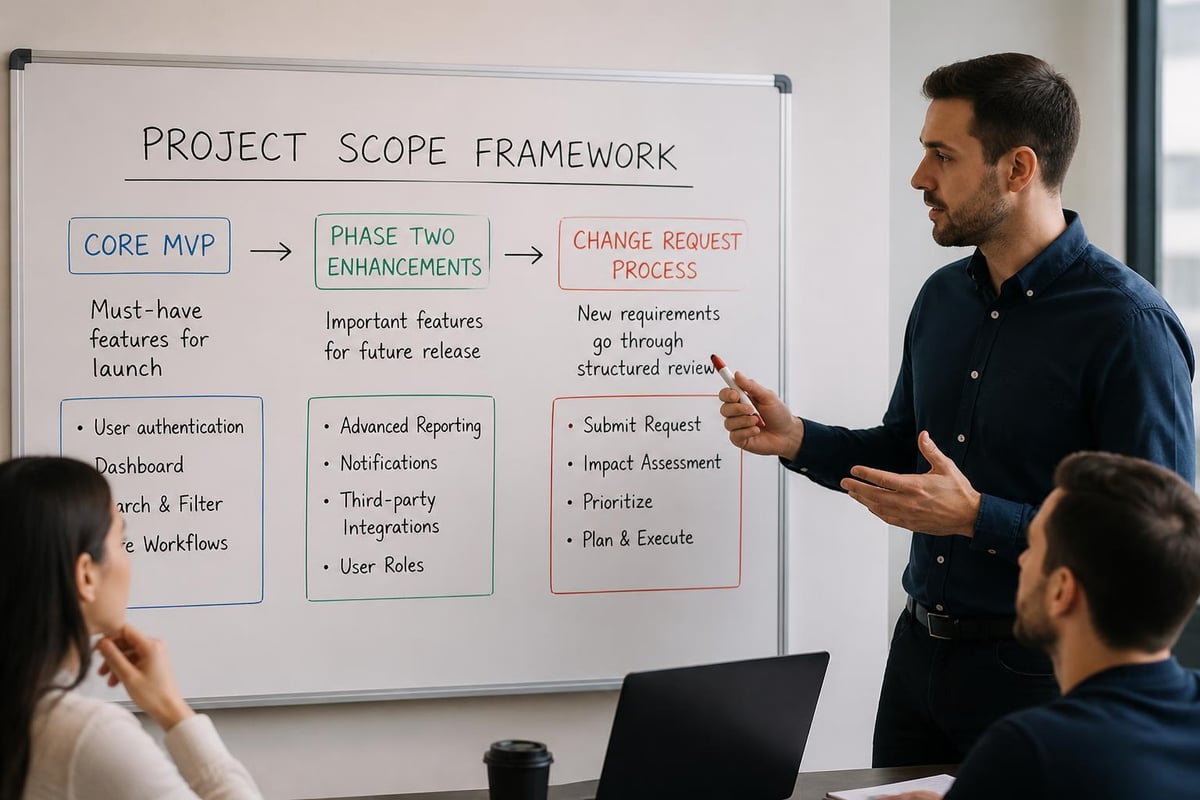
Understand that estimates represent best professional judgement rather than guarantees. Complex features sometimes reveal unexpected challenges during implementation. Developers who pad estimates significantly may be protecting themselves from unrealistic client expectations based on previous experiences.
The decision to hire bubble io developer through an agency versus engaging a freelancer significantly impacts project dynamics, risk, and outcomes. Each model suits different scenarios and founder preferences.
Agencies provide team depth that individual freelancers cannot match. When one developer encounters obstacles or unavailability, others step in without disrupting progress.
Key agency advantages include:
Working with established agencies like those detailed on Bubble.io Developer platforms often means higher costs but reduced risk for complex projects. The investment proves worthwhile when timeline certainty and quality assurance justify premium pricing.
Agencies also provide strategic guidance beyond pure development. Their exposure to numerous projects informs recommendations about feature prioritisation, user experience patterns, and technical architecture decisions.
Individual developers offer flexibility and often lower costs for straightforward projects with well-defined scopes. When you hire bubble io developer as a freelancer, you establish direct communication without intermediary layers.
Freelancers work well for:
The challenge lies in capacity limitations. Freelancers juggle multiple clients, potentially extending timelines when their schedule fills. They also represent single points of failure if illness or personal circumstances interrupt availability.
Evaluate your risk tolerance and project complexity when choosing between models. Critical business applications with tight deadlines generally favour agency partnerships, whilst proof-of-concept builds may suit freelance development.
Your relationship with developers shouldn't end at launch. Applications require maintenance, bug fixes, and feature enhancements as user feedback arrives and your business evolves.
When you hire bubble io developer, discuss post-launch support arrangements before committing. Some developers include limited support periods within project fees, whilst others establish ongoing retainers for continued collaboration.
Budget for ongoing technical support as a percentage of initial development costs. Industry standards suggest 15-25% annually for maintenance and incremental improvements.
Typical post-launch needs include:
Establish response time expectations for different issue severities. Critical bugs affecting core functionality require immediate attention, whilst cosmetic issues can queue for scheduled updates.
Documentation proves invaluable for knowledge transfer if you eventually change developers. Ensure your developer provides technical documentation explaining database structure, workflow logic, and custom code implementations.
Protect your interests through proper contractual frameworks when you hire bubble io developer. Written agreements prevent disputes and clarify expectations around deliverables, timelines, and intellectual property.
Every development agreement should address these critical areas:
| Contract Element | Purpose | Key Details |
|---|---|---|
| Scope of work | Defines deliverables | Specific features and functionality |
| Timeline | Sets expectations | Milestones with completion dates |
| Payment terms | Manages cash flow | Payment schedule tied to milestones |
| IP ownership | Clarifies rights | Transfer of all work product to client |
| Confidentiality | Protects sensitive information | Non-disclosure of business concepts |
| Warranties | Quality assurances | Standards for bug-free delivery |
| Termination clause | Exit mechanisms | Process for ending engagement |
Intellectual property clauses prove particularly important. Ensure contracts specify that you own all work product, including Bubble.io application structure, workflows, and associated assets.
Resources from platforms like Brilworks' hiring process often include contract templates you can adapt for your specific situation. Consulting a solicitor for contract review provides additional protection for substantial projects.
Recognising problematic developers early prevents costly mistakes. Certain behaviours signal potential issues that typically worsen as projects progress.
Warning signs to watch for:
Developers who make guarantees about features Bubble.io cannot deliver demonstrate either dishonesty or insufficient platform knowledge. Both scenarios should eliminate them from consideration.
Trust your instincts about communication compatibility. Developers who dismiss your questions or fail to explain concepts clearly will likely frustrate you throughout the project. The relationship requires mutual respect and effective collaboration.
Similarly, understanding various no-code web development platforms helps you evaluate whether developers are recommending appropriate solutions or simply defaulting to their comfort zone regardless of project fit.
Some Bubble.io developers specialise in particular sectors, bringing domain expertise alongside technical skills. When you hire bubble io developer with industry experience, they understand common workflows, regulatory requirements, and user expectations specific to your market.
Different industries present unique challenges that benefit from specialised knowledge:
Developers with relevant industry background anticipate requirements you might not articulate explicitly. They suggest features based on sector best practices and help avoid compliance pitfalls.
Review how developers approach Bubble web apps differently based on industry context. A booking system for hospitality differs fundamentally from professional services scheduling, despite superficial similarities.
As projects grow in complexity or timelines compress, single developers may prove insufficient. Understanding when and how to scale your development resources prevents bottlenecks that jeopardise launch dates.
Signs you need additional development capacity include:
When you hire bubble io developer as part of a scaling strategy, ensure new team members integrate smoothly with existing resources. Coordination overhead increases with team size, requiring stronger project management.
Agencies handle scaling more seamlessly than assembling ad-hoc freelancer teams. Their developers accustom to collaboration and established processes minimise integration friction.
Remote collaboration requires intentional communication structures and appropriate tooling. When team members span time zones, overlap periods for synchronous communication become precious.
Implement these practices for distributed teams:
Platforms detailed on Bubble IO Development often provide team coordination as part of their service, handling the complexity of managing multiple developers working on shared applications.
Successfully bringing your application concept to life depends heavily on finding the right Bubble.io expertise and establishing productive working relationships. The investment in thorough evaluation and clear communication frameworks pays dividends throughout development and beyond. Whether you're building your first MVP or scaling an existing platform, Creator Concepts brings award-winning expertise in Bubble.io development to entrepreneurs and startups across London and beyond, transforming ideas into market-ready applications with speed and precision.
© 2026 CreatorConcepts Limited
128 City Road, London EC1V 2NX