
Did you know that global social media app usage is expected to reach over 5.85 billion users by 2026, according to Statista? The rapid evolution of social platforms is driving a surge in demand for innovative, secure, and engaging digital experiences. For businesses and entrepreneurs, this presents significant opportunities to connect with audiences through tailored social media app development services.
This comprehensive guide will cover everything you need to know about social media app development services in 2026. We will explore market trends, essential features, the development process, integration and monetisation strategies, choosing the right development partner, and future-proofing your investment.
The social media landscape in 2026 is vibrant, innovative, and more competitive than ever before. Businesses and brands seeking social media app development services must navigate shifting user behaviours, emerging technologies, and evolving regulations. Understanding these dynamics is essential for anyone aiming to launch a successful platform in the years ahead.

The demand for social media app development services is being shaped by a series of powerful trends. Global social media penetration has reached record highs, with over 5 billion users engaging across mobile-first platforms. Mobile devices account for more than 85% of social media traffic, making responsive, mobile-centric design non-negotiable.
Technological advancements have transformed the industry. Artificial intelligence, augmented and virtual reality, and blockchain are redefining how users interact with content and each other. AI, in particular, is revolutionising content moderation, personalisation, and user engagement. For a deep dive into this, see how AI is transforming community apps.
User behaviour is also evolving. There is a marked preference for privacy, niche communities, and authentic connections. Short-form video, live streaming, and interactive content now dominate engagement metrics. Regulatory changes such as GDPR and the Digital Services Act have made compliance and transparent data handling central to all social media app development services.
TikTok and other emerging platforms have set new standards by quickly adapting to these shifts. In 2025 alone, over 1,000 new social media apps launched globally, reflecting the sector’s rapid expansion. The table below summarises key growth drivers:
| Trend | 2026 Impact |
|---|---|
| AI & Automation | Enhanced moderation, content curation |
| AR/VR | Immersive social experiences |
| Blockchain | Data ownership and security |
| Privacy Regulations | Stricter compliance, user trust |
| Short-Form Video | Higher user retention and engagement |
Social media app development services are no longer limited to general platforms. A surge in niche and community-driven networks is reshaping the market. Professional networking apps now focus on B2B communities and industry-specific collaboration, going beyond LinkedIn’s traditional model.
Dating and friendship apps have evolved with advanced matching algorithms and tailored experiences. Interest-based micro-communities, inspired by platforms like Reddit, provide spaces for in-depth discussions and shared passions. Social gaming and entertainment apps blend real-time interaction with immersive experiences, while social commerce platforms integrate influencer marketing and direct shopping features.
Consider these examples of niche innovation:
This diversity means that businesses seeking social media app development services must identify their unique value proposition. The table below highlights emerging app types and their core features:
| App Type | Key Features |
|---|---|
| Professional | B2B networking, industry forums |
| Dating/Friendship | Personalised matching, secure chats |
| Micro-Community | Topic boards, voting, moderation |
| Gaming | Multiplayer, leaderboards, live events |
| Social Commerce | In-app shops, influencer integration |
These niches reflect a broader trend towards platforms that serve specific interests, foster loyalty, and deliver deeper engagement.
User expectations have never been higher, and social media app development services must deliver seamless, intuitive experiences. Modern users demand effortless onboarding, fast navigation, and visually engaging interfaces. Accessibility is now standard, with apps required to meet inclusive design criteria for all users.
AI-driven personalisation tailors content, notifications, and recommendations, increasing retention and satisfaction. Security, privacy, and transparent data practices are central to user trust. End-to-end encryption, clear privacy controls, and regular compliance updates are now expected features.
Leading apps have reimagined their design strategies for 2026. For example, top platforms now conduct regular accessibility audits and use real user feedback to guide UI/UX improvements. The result is a generation of social media app development services focused on delivering both innovation and reliability.
As the market evolves, brands that prioritise user-centric design, robust security, and continuous personalisation will stand out. These standards are no longer optional, but essential for success in 2026 and beyond.
In 2026, the expectations for social media app development services have never been higher. Users demand seamless, secure, and engaging experiences from every platform they join. To stand out in a competitive landscape, your app must include a robust mix of core functionalities, advanced integrations, and best-in-class security features. Let us explore the essential elements that define successful social media applications for the modern era.
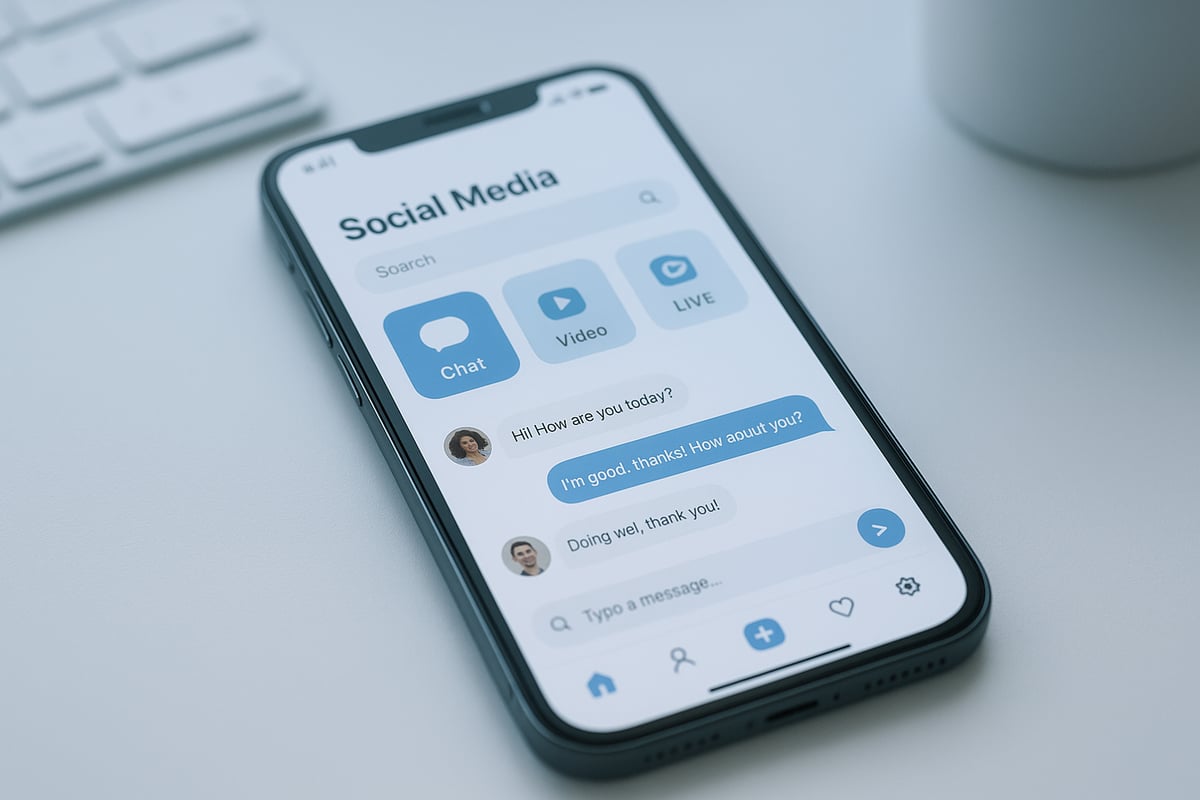
Every leading social media app in 2026 is built on a foundation of indispensable features. Frictionless onboarding through social login and single sign-on (SSO) ensures users can join quickly, minimising barriers to entry. Real-time messaging, chatbots, and AI-powered moderation are now standard, letting users connect instantly and safely.
Content creation is at the heart of user engagement. Your platform should support video uploads, image sharing, ephemeral stories, and live streaming to keep audiences active and invested. News feeds and timelines, enhanced by algorithm-driven content curation, help users discover relevant updates and foster ongoing interaction.
Push notifications and in-app alerts are vital for maintaining engagement. They remind users of new content, messages, or events, encouraging frequent returns. Below is a summary of core functionalities:
| Feature | Description |
|---|---|
| Social login/SSO | Quick, easy onboarding |
| Real-time messaging | Instant, secure conversations |
| Content creation tools | Video, image, story, live stream support |
| News feeds/timelines | Algorithm-driven content curation |
| Push notifications | User engagement and retention |
To compete effectively, social media app development services must ensure these features are flawlessly implemented.
Modern users expect more than the basics. Advanced integrations elevate user experience and open new avenues for growth. Embedded social feeds and cross-platform sharing empower your audience to distribute content across networks, increasing reach and brand visibility.
In-app purchases, donations, and social commerce features facilitate direct monetisation. Analytics dashboards provide valuable insights into user behaviour, letting you adapt your platform to trends. Event scheduling, RSVPs, and calendar integration encourage community participation and real-world engagement.
Maps, geolocation, and local discovery tools are now common, especially in apps focused on communities or local events. These functionalities help users connect with others nearby and participate in relevant activities. For those seeking to build a scalable platform, exploring Best Practices for Scalable Social Media App Development can offer valuable guidance on integrating these advanced features efficiently.
Social media app development services in 2026 must provide flexible, modular solutions to accommodate these integrations, ensuring platforms stay adaptable and future-ready.
Trust and safety are at the forefront of user concerns in 2026. End-to-end encryption for messaging and data ensures privacy in every interaction. GDPR and DSA compliance tools, alongside user data controls, are non-negotiable for operating in global markets.
Content moderation is powered by AI and human oversight, enabling rapid detection and removal of harmful material. Automated reporting and filtering systems give users the tools to protect themselves and foster positive communities.
Two-factor authentication and biometric login options, such as fingerprint or facial recognition, enhance account security. Enterprise social networks have demonstrated the effectiveness of these features, making them standard for any reputable platform.
To succeed, social media app development services must prioritise security, transparency, and regular compliance updates. Only by embedding these values into your platform can you build lasting trust with users and stakeholders.
Launching a successful social platform in 2026 requires following a proven, structured process. Social media app development services are now more sophisticated than ever, supporting businesses from idea to launch and beyond. Let us walk through each step, highlighting best practices, industry standards, and emerging methods for building robust, engaging, and secure apps.

Every successful project with social media app development services begins with a thorough discovery phase. This involves understanding the client's vision, objectives, and target audience through stakeholder interviews and workshops.
Analysing competitors and current market trends helps define unique value propositions and identify opportunities. Social media app development services prioritise features at this stage, often recommending an MVP (Minimum Viable Product) to test core ideas quickly.
For example, the agency "You are launched" structures requirement analysis around detailed user personas and business goals. Their approach ensures alignment between stakeholders and developers, setting a clear roadmap for design and delivery.
A well-executed discovery phase reduces costly revisions later and lays the foundation for scalable, future-proof solutions.
Design is a cornerstone of effective social media app development services. The process kicks off with mapping user journeys and developing personas to anticipate user needs and behaviours.
Wireframes are created to outline the app's structure, followed by detailed prototypes that visualise interactions and flows. Both low- and high-fidelity models are tested with real users to gather feedback and refine usability.
Accessibility and inclusivity are non-negotiable. Leading agencies ensure designs meet global standards, making apps usable for everyone. Competitor agencies often showcase their UI/UX stages, emphasising iterative design, rapid prototyping, and ongoing feedback loops.
The outcome is an intuitive, visually appealing interface that fosters engagement and retention.
Once design is approved, development commences. Social media app development services select the most suitable technology stack, whether native, cross-platform, or no-code/low-code solutions. Backend development includes building APIs, databases, and scalable cloud infrastructure.
Frontend teams work on mobile (iOS, Android), web, or PWA versions, integrating essential features and third-party services such as analytics or payment gateways. Modern frameworks like Bubble.io enable rapid prototyping and cost efficiency. For those interested in innovative, code-free approaches, No-code app design strategies offer valuable insights into accelerating development without compromising quality.
Agencies ensure every feature aligns with business goals, regulatory requirements, and user expectations.
Rigorous QA is integral to social media app development services. Testing spans functionality, performance, security, and compliance across all devices and operating systems.
Automated and manual test cases are implemented to catch bugs early. User Acceptance Testing (UAT) involves real users validating the app against requirements. Compliance checks, such as accessibility and GDPR, are performed before launch.
Competitor QA processes often include detailed checklists and regression testing cycles. This meticulous approach ensures a stable, secure, and bug-free experience for end users.
Deployment is a milestone in social media app development services. Teams prepare the app for submission to Apple App Store and Google Play, optimising metadata and visuals for discoverability.
Web deployment involves configuring servers and setting up security protocols. A phased roll-out strategy, including beta testing or soft launches, helps gather feedback and address issues before a full release.
Agencies monitor analytics from day one and use competitor launch checklists to ensure nothing is overlooked. This step maximises visibility and user adoption at launch.
After launch, social media app development services transition to ongoing support. Teams address bug fixes, release feature updates, and plan for scalability. Regular security patches and compliance updates are essential to protect user data and maintain trust.
User feedback is collected through built-in channels, informing future improvements. Agencies offer service level agreements (SLAs) and support packages, ensuring rapid response to any issues.
Competitor agencies highlight transparent maintenance offerings, helping clients focus on growth while the technical team manages stability and innovation.
The landscape of social media app development services in 2026 is rapidly transforming. To remain competitive, apps must deliver seamless integrations, robust monetisation options, and innovative growth strategies. Let us explore how these elements work together to drive success in the evolving digital ecosystem.

Modern social media app development services focus on building platforms that connect users in increasingly dynamic ways. Essential integrations include:
Leading agencies often provide APIs for seamless third-party integrations, allowing apps to adapt quickly to new technologies. By prioritising these capabilities, social media app development services ensure platforms remain flexible and future ready.
Seamless integration with trending features keeps users engaged and encourages organic community growth. It also supports efficient data-driven decision making for brands and startups alike.
To generate sustainable revenue, social media app development services must incorporate diverse monetisation models. Popular strategies include:
The integration of social commerce has become particularly influential. According to Social Commerce Market Projections, the market for social commerce is set to experience significant growth, making it a key opportunity for app owners.
Case studies from leading dating and gaming apps demonstrate how layered revenue streams can boost user engagement and platform profitability. By leveraging advanced monetisation tools, social media app development services help brands unlock new value from digital communities.
Growth strategies are crucial for any successful app. Social media app development services employ a range of tactics to acquire and retain users:
Retention tactics used by successful apps often involve continuous engagement, regular feature updates, and responsive support. A focus on user feedback and analytics allows developers to refine experiences and maintain a loyal user base.
Ultimately, by combining these acquisition and retention methods, social media app development services create platforms that scale efficiently and foster long-term growth.
Selecting the ideal partner for your social media app development services is a major decision that can shape your project's success. With a growing number of agencies and freelancers in the market, it is essential to evaluate each option with care. The right development partner will not only bring technical expertise but also strategic insight and a commitment to quality.
When considering social media app development services, start by reviewing the agency’s experience within your industry. A proven track record in building scalable, secure, and engaging social platforms is vital.
Examine their portfolio for relevant case studies, especially those involving communities, influencer networks, or niche audiences. Technical skills matter, so assess their expertise in native, cross-platform, and no-code solutions. Security credentials, GDPR compliance, and data protection should be non-negotiable.
Communication is another key factor. Choose an agency that offers transparent project management and regular updates. Client reviews, testimonials, and third-party ratings provide valuable insight into their reliability and client satisfaction.
For a comprehensive comparison of top agencies, you may find the Community app development companies UK review helpful for identifying trusted partners in the field.
Before finalising your choice, prepare a list of essential questions to ensure your social media app development services provider aligns with your vision. Consider asking:
These questions will help you gauge an agency’s transparency, technical proficiency, and dedication to long-term success. A strong partner will answer confidently and provide examples to back up their claims.
Budgeting for social media app development services requires careful planning. Costs are influenced by app complexity, feature set, integrations, and development timelines. Agencies may offer fixed, hourly, or milestone-based pricing models.
For MVPs, expect a lower budget range, while full-featured platforms will require a larger investment. Always request a detailed proposal outlining deliverables, timelines, and payment schedules. Clear contracts and agreed milestones help prevent misunderstandings.
Refer to industry benchmarks and competitor case studies to set realistic expectations. Prioritise transparency in pricing and ensure your chosen agency is open about all potential costs. This approach minimises risk and fosters a strong, collaborative relationship.
Anticipating the future is essential for anyone investing in social media app development services. As technology advances, staying ahead of the curve ensures long-term relevance and competitiveness in a rapidly evolving digital ecosystem.
The landscape for social media app development services is set for dramatic transformation beyond 2026. Artificial intelligence will further enhance personalisation, content moderation, and predictive engagement. Augmented and virtual reality will support immersive social interactions, while blockchain will empower decentralised networks and user-owned data. The arrival of 5G and 6G connectivity will enable real-time experiences with minimal latency.
According to recent app development trends for 2026, the industry will see rapid integration of these technologies, making them foundational for next-generation platforms. Businesses must monitor these shifts to ensure their social media app development services remain future-proof and competitive.
New privacy laws and digital rights management requirements will continue to shape social media app development services. Flexibility in codebase and architecture will allow businesses to adapt quickly to regulatory updates. Embracing open-source frameworks and community-driven development can foster transparency and trust.
The move towards community-first platforms highlights the importance of authentic engagement and agile compliance. To stay ahead, companies should build social media app development services that are ready to pivot, update, and respond to evolving user needs and legal standards.
Scalability is a core component of future-ready social media app development services. Multilingual support and localisation are now expected features, enabling global user acquisition. Adopting cloud-native, serverless, and edge computing architectures ensures high performance and reliability, even as user numbers surge.
Advanced analytics are crucial for tracking international growth and optimising feature rollouts. By embedding scalable infrastructure and robust analytics, social media app development services can support expansion into new markets and maintain seamless user experiences worldwide.
Between 2024 and 2026, several social media platforms achieved remarkable growth by embracing forward-thinking strategies. For example, Viewranger leveraged cloud-native technology to scale its community features. Slide rapidly adapted its privacy controls to comply with new regulations, earning user trust and loyalty.
These examples demonstrate that successful social media app development services combine technological innovation, regulatory agility, and a commitment to user experience. Learning from these leaders helps inform the next generation of app development projects.
As you’ve seen throughout this guide, the landscape of social media app development in 2026 is filled with opportunities for innovation, growth, and meaningful engagement. Whether you’re looking to harness AI driven features, prioritise robust security, or launch a scalable platform without code, the right partner makes all the difference. At Creator Concepts, we specialise in bringing ambitious ideas to life with award winning no code solutions tailored to your needs. If you’re ready to explore how your vision can shape the future of social media, Book a discovery call and let’s move your project forward together.
© 2026 CreatorConcepts Limited
128 City Road, London EC1V 2NX