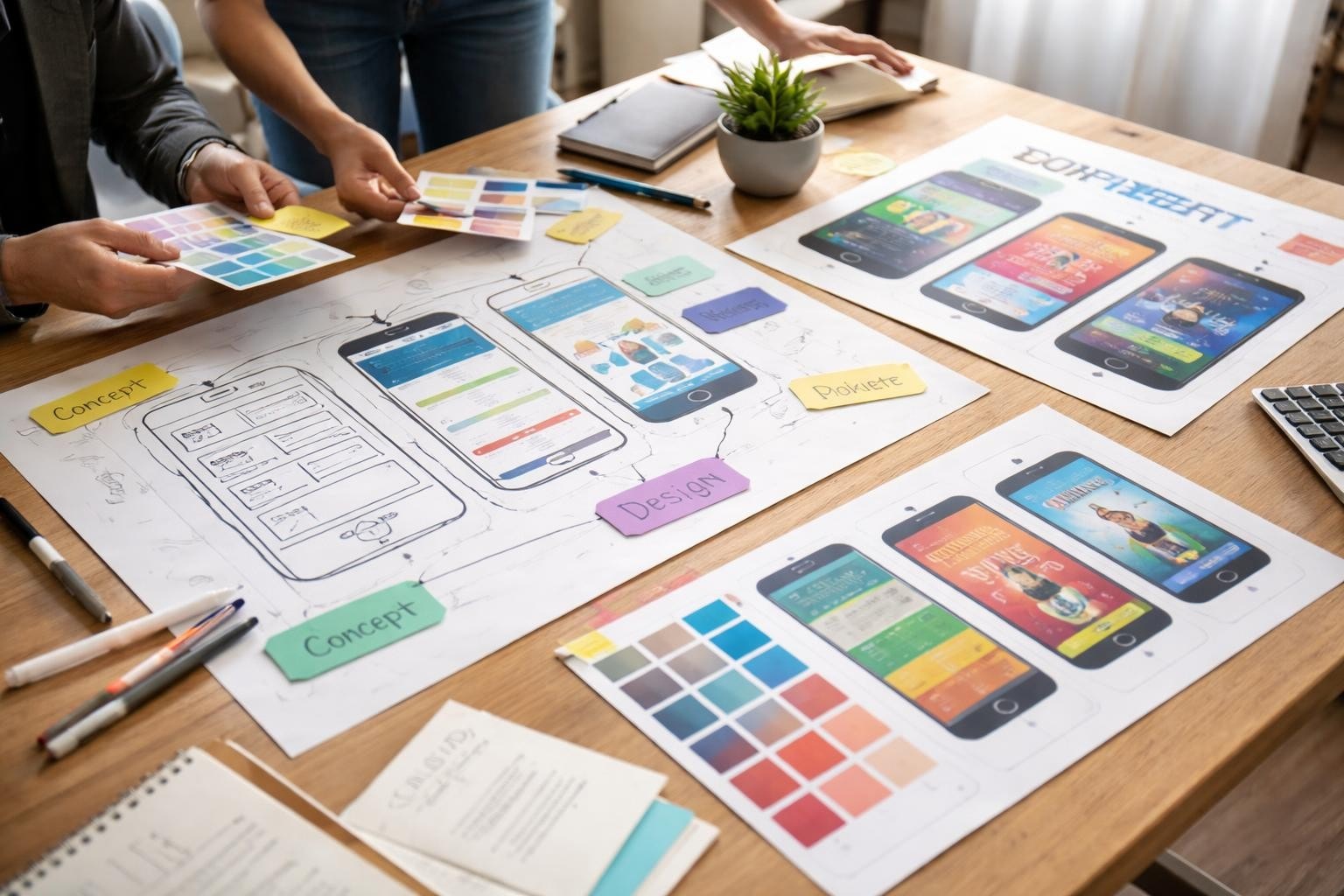

The success of any mobile application depends heavily on how effectively you communicate its value proposition to potential users. App creative encompasses the visual assets, messaging, and design elements that drive user acquisition, engagement, and retention across app stores and advertising platforms. For founders building MVPs and scaling startups, mastering app creative strategy becomes essential to stand out in an increasingly competitive marketplace where over 2.3 million apps vie for attention in major app stores.
App creative represents the complete visual and textual identity of your application across every customer touchpoint. This encompasses app store assets, paid advertising materials, and user interface elements that collectively shape how users perceive and interact with your product.
The core components include app icons, screenshots, preview videos, feature graphics, and advertising creatives distributed across platforms like Google Ads, Facebook, TikTok, and Apple Search Ads. Each element serves a distinct purpose in the user acquisition funnel.
App icons serve as the first impression and require careful consideration of color psychology, simplicity, and brand recognition. Your icon appears in search results, on home screens, and within app stores, making it one of the most frequently viewed brand elements.
Screenshots and preview videos demonstrate functionality and value propositions. App store graphics play a critical role in conversion rates, with the first three screenshots carrying the most weight in user decision-making. These visuals should highlight key features, showcase the user interface, and communicate benefits rather than merely displaying screens.
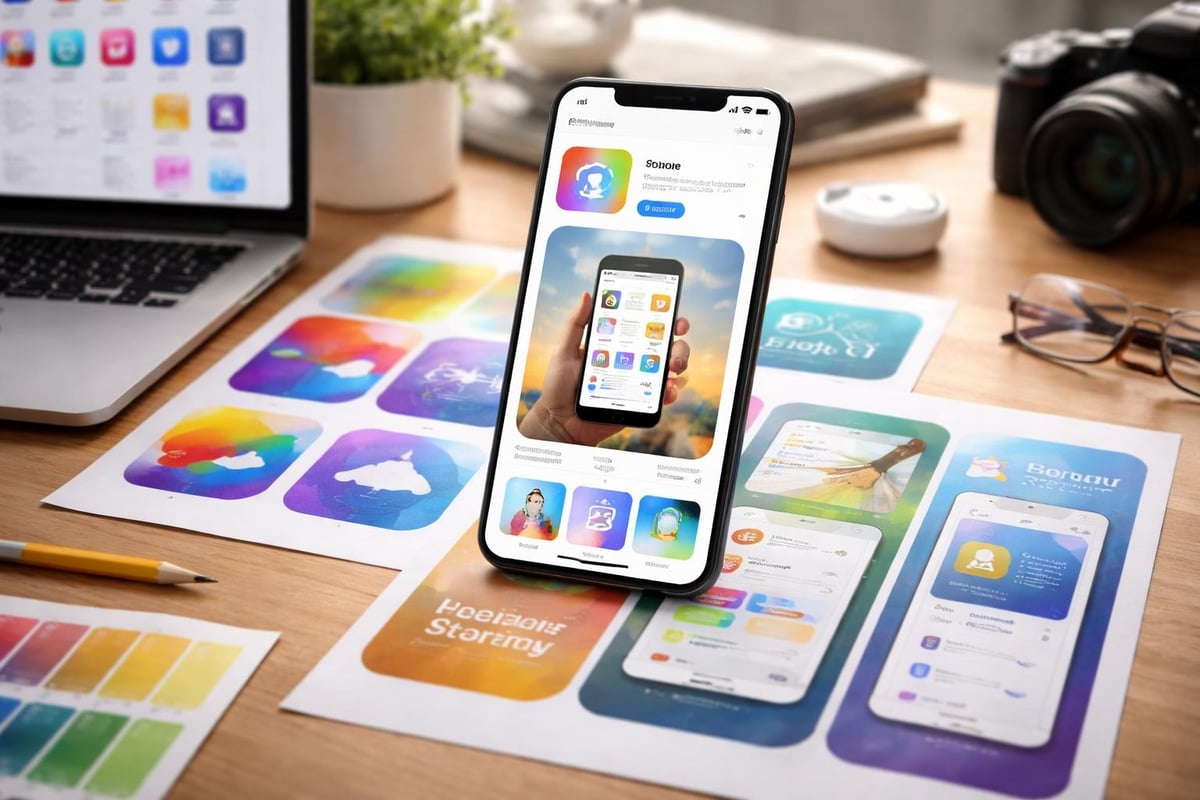
Feature graphics and promotional artwork appear prominently in app store listings and social media campaigns. These larger-format visuals provide opportunities to communicate brand personality and differentiate your application from competitors.
Successful app creative development requires a systematic approach that balances brand consistency with platform-specific optimization. The process begins with understanding your target audience and their motivations for seeking solutions in your category.
User research informs every creative decision. Demographic data, psychographic profiles, and behavioral patterns reveal which visual styles, messaging frameworks, and value propositions resonate most effectively. For startup founders working with limited budgets, this research prevents wasted spend on creatives that fail to connect.
When developing MVP Development projects, we've observed that founders often overlook the importance of app creative until late in the development cycle. Integrating creative strategy from the initial planning stages ensures visual consistency and clearer communication of core features.
| Creative Element | Primary Purpose | Conversion Impact |
|---|---|---|
| App Icon | Brand recognition, first impression | High |
| Screenshots | Feature demonstration, UI preview | Very High |
| Preview Video | Engagement, comprehensive overview | Medium-High |
| Ad Creatives | User acquisition, retargeting | Very High |
Testing multiple creative variations helps identify winning combinations. A/B testing reveals which headlines, visuals, and calls-to-action drive the highest conversion rates. Think with Google emphasizes the importance of featuring your app early in video creatives and building diverse portfolios of creative assets.
Different advertising platforms and app stores require tailored approaches to app creative. What performs well on TikTok may not translate to Google App Campaigns or Apple Search Ads.
Video length varies by platform. IronSource recommends keeping mobile ad videos between 15-30 seconds, with the most critical messaging delivered within the first three seconds. TikTok users expect native, less polished content, whilst LinkedIn audiences respond to more professional presentations.
Format requirements differ substantially. Instagram Stories demand vertical 9:16 formats, whilst YouTube accommodates horizontal 16:9 ratios. Planning your app creative production around these specifications prevents costly reshoots and ensures optimal display across channels.
Modern app creative balances aesthetic appeal with functional clarity. Best practices for app design in 2024 emphasize user-centric approaches, personalization, accessibility standards, and minimalist design principles that have continued to evolve into 2026.
Consistency across all creative touchpoints builds trust and recognition. Your color palette, typography, iconography, and tone of voice should remain coherent whether users encounter your brand in an Instagram ad, App Store listing, or within the application itself.
Effective app creative guides the viewer's attention through deliberate visual hierarchy. Size, color, contrast, and positioning direct focus to the most important elements first.
White space prevents cognitive overload. Cramming excessive information into screenshots or ad creatives reduces comprehension and diminishes impact. Strategic use of negative space creates breathing room that enhances readability and focus.
For founders considering app development for non-technical founders, understanding these design principles early helps communicate requirements to development teams and ensures creative assets align with technical capabilities.
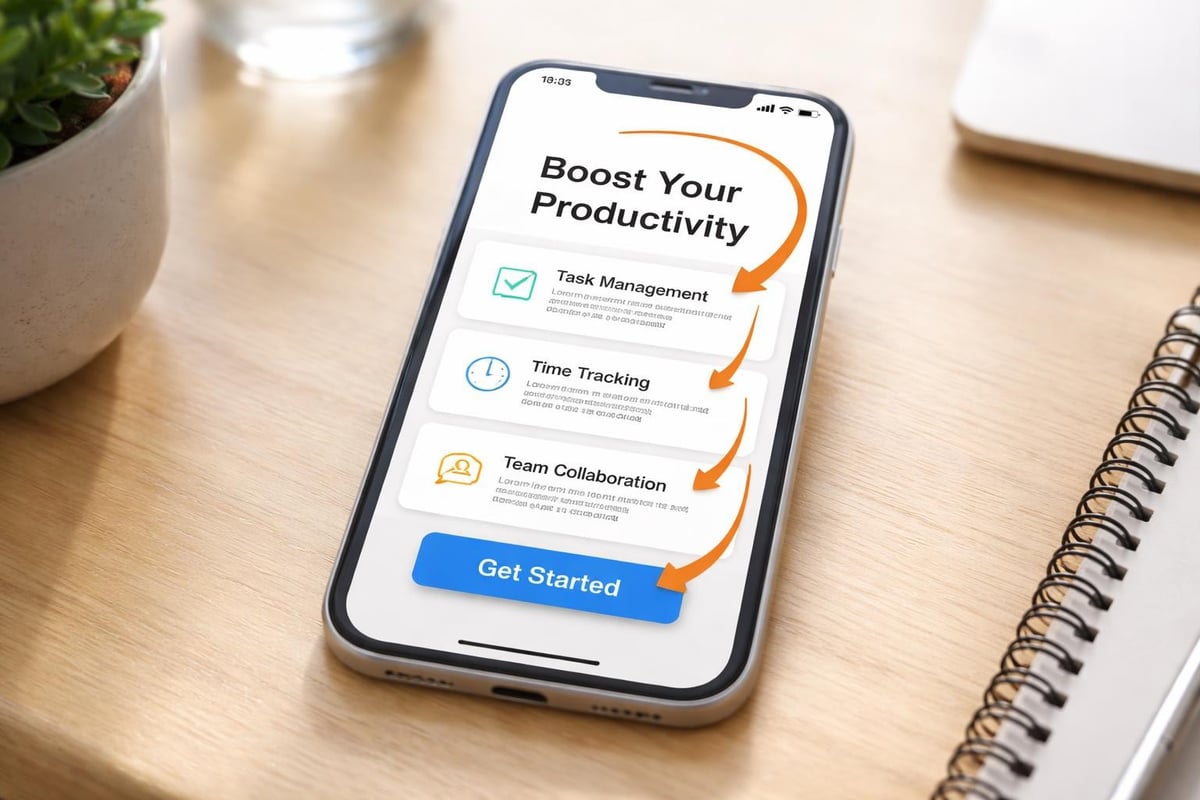
Paid user acquisition represents a significant investment for startups, making creative optimization essential for sustainable growth. Poor app creative wastes advertising budgets on impressions that never convert to installs.
Google's Universal App Campaigns (UAC) automate much of the campaign management process but still require high-quality creative inputs. DEPT® outlines that providing diverse text variations, multiple image formats, HTML5 creatives, and video content gives the algorithm more options to test and optimize.
Text assets should vary in length and messaging angle. Create headlines emphasizing different benefits: time savings, cost reduction, social connection, productivity gains, or entertainment value. Google's machine learning identifies which combinations resonate with specific audience segments.
HTML5 creatives offer interactive experiences that stand out in display placements. These engaging formats typically achieve higher click-through rates than static images, particularly for utility and productivity applications.
TikTok's Smart+ App Campaigns require minimum campaign durations and sufficient creative volume for effective optimization. The platform recommends uploading at least 5-10 creative variations to enable meaningful iteration.
Authenticity drives performance on TikTok. Overly produced, corporate-style app creative often underperforms compared to user-generated content styles that feel native to the platform. Featuring real users, behind-the-scenes development footage, or founder stories creates connection and trust.
Platform-specific creative tips:
When developing no-code web development platforms and applications, rapid creative iteration becomes possible without extensive technical resources. This agility enables startups to test messaging and positioning more frequently.
App Store Optimization (ASO) extends beyond keywords and ratings to encompass every visual element in your store listing. App creative directly impacts conversion rates for organic traffic, making it a crucial component of sustainable user acquisition.
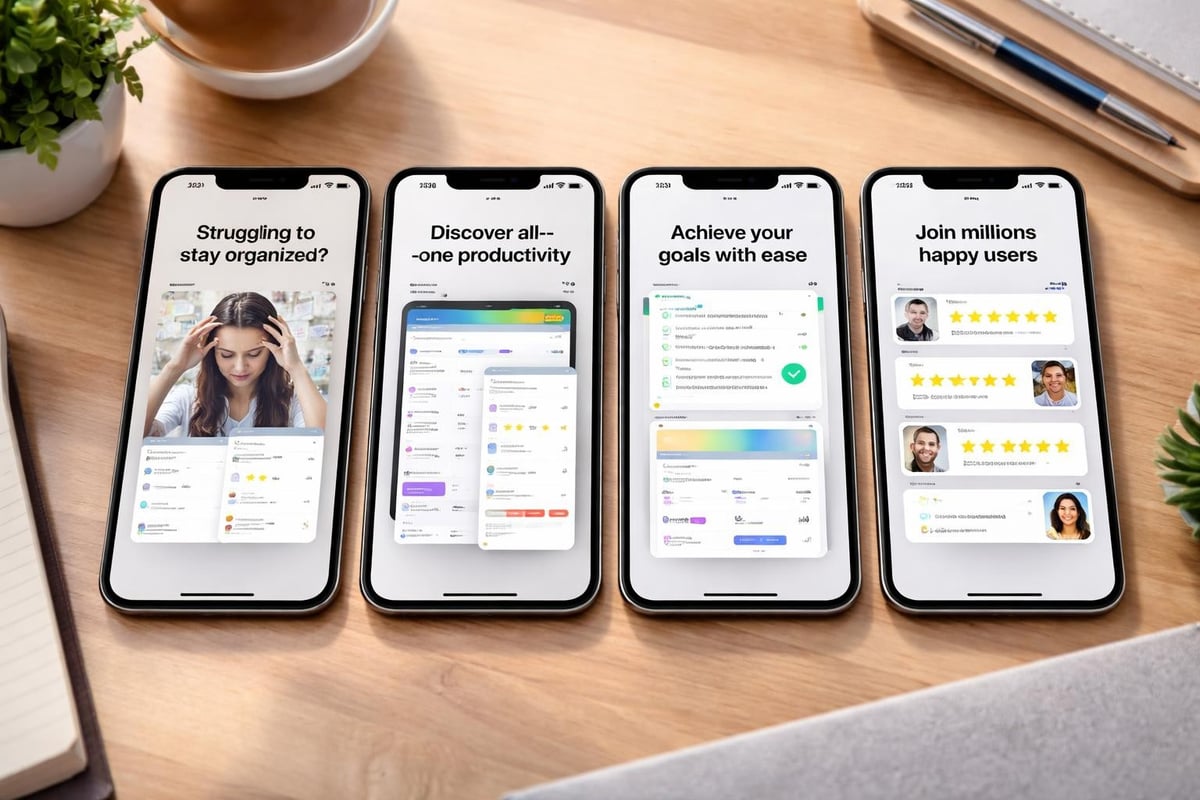
Your screenshot gallery tells a story about the user journey and transformation your app enables. Rather than simply displaying interface screens, craft a narrative sequence that guides prospective users through problem recognition, solution discovery, and outcome visualization.
The first screenshot carries disproportionate weight since many users never scroll beyond it. This primary image should communicate your core value proposition with minimal text and maximum clarity. Consider featuring before-and-after states, completed outcomes, or satisfied user experiences rather than empty states or login screens.
| Screenshot Position | Strategic Purpose | Content Recommendation |
|---|---|---|
| 1st Screenshot | Hook & value proposition | Primary benefit with social proof |
| 2nd-3rd Screenshots | Key features | Most compelling functionality |
| 4th-5th Screenshots | Secondary benefits | Additional features or use cases |
| 6th+ Screenshots | Trust signals | Awards, testimonials, security features |
Localization matters for apps targeting multiple markets. App creative should adapt to cultural preferences, language nuances, and regional design sensibilities rather than simply translating text.
Data-driven optimization separates high-performing app creative from mediocre attempts. Systematic testing reveals insights that intuition alone cannot provide.
Begin with controlled A/B tests that isolate single variables. Test one element at a time: headline variations, color schemes, featured benefits, or visual styles. Changing multiple elements simultaneously makes it impossible to attribute performance changes to specific factors.
Sample size and statistical significance determine test validity. Rushing to conclusions based on insufficient data leads to poor decisions. Most meaningful tests require several thousand impressions per variation to achieve confidence in results.
Key performance indicators for app creative include:
Retention metrics reveal whether your app creative attracts the right users. High install volumes coupled with poor retention suggest misleading creative that sets incorrect expectations. Alignment between creative messaging and actual app experience drives sustainable growth.
The app creative landscape continues evolving as user preferences shift and new technologies emerge. Staying current with these trends helps maintain competitive advantage.
Interactive preview experiences are becoming standard expectations. Users want to experience core functionality before installing, leading to increased adoption of playable ads and interactive demos that simulate actual app usage.
Personalization extends to creative assets. Dynamic creative optimization generates custom ad variations based on user demographics, behavior patterns, and contextual signals. This tailored approach improves relevance and conversion rates.
Using imagery effectively in app design now encompasses AI-generated visuals, 3D elements, and augmented reality previews that showcase applications in realistic usage contexts. These advanced formats differentiate premium applications from basic competitors.
Sustainability and ethical design considerations influence creative decisions. Users increasingly favor brands that communicate environmental responsibility, data privacy commitments, and inclusive design practices through their visual identity.
Video dominates user attention across social platforms and app stores. Short-form video content drives higher engagement than static images, making it essential for user acquisition strategies.
Tutorial-style videos that demonstrate problem-solving build credibility. Rather than simply showcasing features, these educational creatives position your app as the solution to specific pain points your target audience experiences.
User-generated content (UGC) videos outperform professionally produced alternatives in many categories. Real customers sharing authentic experiences create social proof that polished marketing cannot replicate. Encouraging and curating UGC becomes a valuable app creative strategy.
For startups exploring tools for community app development, video creative showcasing active community interactions and member success stories proves particularly effective at attracting engaged users.
Limited budgets needn't constrain creative quality. Strategic resource allocation and modern tools enable startups to produce professional app creative without agency-level spending.
Stock photography and video libraries provide affordable visual assets when original photography isn't feasible. Services like Unsplash, Pexels, and Adobe Stock offer high-quality imagery that can be customized to match brand guidelines.
Design tools have democratized creative production. Canva, Figma, and Adobe Express enable non-designers to create polished app store assets and advertising creatives through templates and intuitive interfaces. These platforms reduce dependence on expensive designers for every creative iteration.
Screen recording software captures authentic app demonstrations for preview videos. Tools like Loom, ScreenFlow, or OBS Studio enable founders to create walkthrough videos showcasing real functionality without complex production setups.
Budget-friendly app creative resources:
Investing effort in fewer, higher-quality creatives often outperforms producing numerous mediocre assets. Thoughtful strategy matters more than volume.
Each app store and advertising platform maintains specific requirements for app creative assets. Non-compliance results in rejection, delays, and wasted resources.
Apple's App Store guidelines prohibit misleading screenshots, inappropriate content, and intellectual property violations. Android's Google Play Store enforces similar standards whilst allowing slightly more creative flexibility in certain categories.
Advertising platforms add additional restrictions. Facebook and Instagram limit text overlay to 20% of image area in some placements. TikTok prohibits certain claims and requires disclosure of AI-generated content.
Trademark usage requires careful attention. Featuring competitor names, comparing your app to others, or using protected logos without permission violates platform policies and exposes you to legal risk.
Regular guideline reviews prevent compliance issues. Platform policies evolve quarterly, and staying informed protects your launch timeline and advertising investments.
Mastering app creative transforms user acquisition from expensive guesswork into predictable growth. By applying strategic frameworks, testing systematically, and iterating based on performance data, founders build creative assets that efficiently convert prospects into engaged users. Whether you're launching your first MVP or scaling an established product, Creator Concepts helps entrepreneurs develop applications paired with compelling creative strategies that drive sustainable growth in competitive markets.
© 2026 CreatorConcepts Limited
128 City Road, London EC1V 2NX