

App development projects have evolved dramatically in recent years, with founders and startups now having access to powerful tools and methodologies that democratise the creation of sophisticated digital products. Whether you're launching your first mobile application or scaling an existing platform, understanding the fundamental principles of successful project execution can mean the difference between a product that resonates with users and one that fails to gain traction. This comprehensive guide explores the essential elements that drive app development projects forward, from initial planning and scope definition through to launch and beyond.
The foundation of any successful application begins with clarity of purpose and a well-defined scope. App development projects typically fail not due to technical limitations but because teams lose sight of the core problem they're solving. Before writing a single line of code or creating your first wireframe, you must articulate precisely what value your application delivers to its intended users.
Clear objectives serve as your project's north star. They should be specific, measurable, and directly tied to business outcomes rather than technical features. For instance, "increase user engagement by 40%" provides better direction than "add a chat feature."
Key elements of effective scope definition include:
When founders approach MVP Development needs, the most successful projects begin with ruthless prioritization. This means identifying the minimum viable feature set that validates your core hypothesis rather than building everything you envision.

The landscape of app development has expanded beyond traditional coding to include powerful no-code and low-code platforms. Your choice of approach should reflect your timeline, budget, technical resources, and long-term scalability needs.
| Development Approach | Timeline | Cost | Flexibility | Best For |
|---|---|---|---|---|
| Traditional Native | 6-12+ months | £50k-200k+ | High | Complex, performance-critical apps |
| Cross-Platform | 3-8 months | £30k-100k | Medium-High | Multi-platform deployment |
| No-Code Platforms | 2-12 weeks | £5k-30k | Medium | MVPs, rapid validation |
| Hybrid Approach | 4-10 months | £25k-80k | Medium | Balanced requirements |
No-code web development platforms have matured significantly, enabling entrepreneurs to build sophisticated applications without extensive programming knowledge. These platforms excel particularly in the validation phase, allowing you to test market fit before committing to larger investments.
Selecting the appropriate project management methodology significantly impacts your app development project's success trajectory. Different approaches suit different project types, team structures, and organizational cultures.
Agile methodologies have become the dominant approach in app development projects because they accommodate the inherent uncertainty in creating new digital products. Rather than attempting to define every feature upfront, Agile embraces iterative development with regular feedback loops.
Core Agile principles for app development include:
This approach allows you to adapt to changing market conditions, user feedback, and technical discoveries without derailing the entire project. Effective project management for app development requires balancing structure with flexibility, ensuring teams have clear direction whilst remaining responsive to new information.
For teams seeking more fluid workflows, Kanban offers an alternative to time-boxed sprints. This methodology visualizes work in progress, limits concurrent tasks, and optimizes flow efficiency.
Kanban boards typically organize work across columns representing different stages:
This approach works particularly well for SaaS app development projects requiring continuous updates and improvements based on user behavior and feedback.
The tools you select for your app development project create the operational infrastructure supporting your team's productivity and collaboration. Modern project management demands integration between planning, development, and communication platforms.
Selecting appropriate project management software creates a single source of truth for your team, reducing miscommunication and ensuring everyone understands priorities and progress.
Leading platforms offer these essential capabilities:
The best tool for your specific project depends on team size, complexity, and existing technology stack. Smaller teams often benefit from simpler tools like Trello or Asana, whilst enterprise projects may require more robust solutions like Jira or Monday.com.
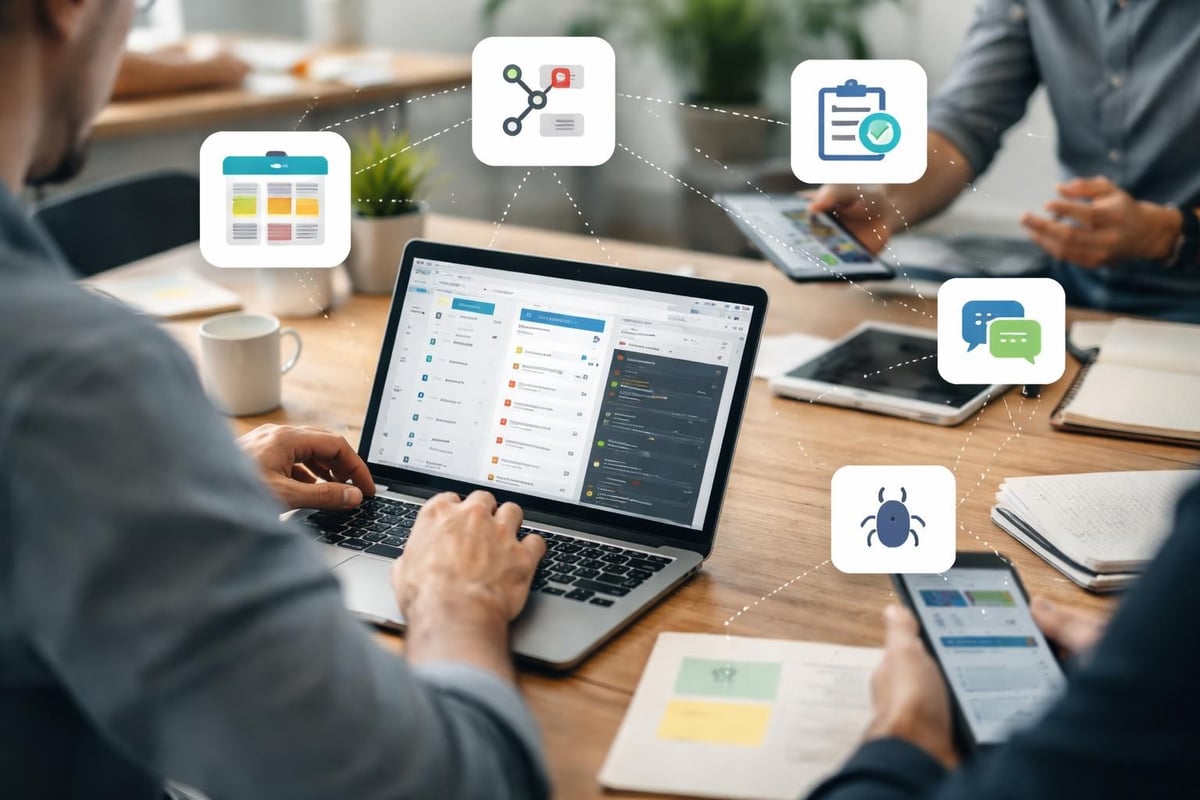
Beyond project management, successful app development projects require robust development environments, version control, and communication infrastructure.
| Tool Category | Purpose | Popular Options |
|---|---|---|
| Version Control | Code management and collaboration | GitHub, GitLab, Bitbucket |
| Communication | Team coordination | Slack, Microsoft Teams, Discord |
| Design | UI/UX prototyping | Figma, Adobe XD, Sketch |
| Testing | Quality assurance | TestFlight, Firebase, BrowserStack |
| Analytics | User behavior tracking | Mixpanel, Amplitude, Google Analytics |
For no-code app development projects, platforms like Bubble.io integrate many of these functions within a single environment, streamlining workflows and reducing tool fragmentation.
Design quality separates applications that users embrace from those they abandon after a single session. App development projects must prioritize user experience from the earliest planning stages rather than treating design as a cosmetic afterthought.
Every design decision should stem from understanding actual user needs, behaviors, and contexts. This requires research before design and validation after implementation.
Effective user-centered design involves:
The cost of fixing usability issues increases exponentially as development progresses. Identifying navigation problems during prototyping costs hours; discovering the same issues after launch costs weeks of redevelopment plus potential user churn.
Modern app development projects must account for diverse devices, screen sizes, and usage contexts. Users expect seamless experiences whether they're accessing your application on a smartphone, tablet, or desktop computer.
Responsive design approaches automatically adjust layouts based on screen dimensions, whilst adaptive design serves different layouts for specific device categories. Many successful applications combine both strategies, optimizing critical workflows for mobile whilst providing expanded functionality on larger screens.
The actual building phase of app development projects demands discipline, quality standards, and systematic approaches to minimize technical debt whilst maximizing development velocity.
Even when using no-code platforms, maintaining clean, organized, and well-documented application architecture prevents future headaches. Poorly structured applications become increasingly difficult to modify, debug, and scale as they grow.
Fundamental quality practices include:
Google Cloud's application management best practices emphasize alignment between technical architecture and business objectives, ensuring technical decisions support rather than hinder business goals.
Systematic testing prevents costly post-launch issues and builds user trust through reliability. App development projects require multiple testing layers, each addressing different potential failure modes.
| Testing Type | Purpose | When Applied |
|---|---|---|
| Unit Testing | Individual component validation | During development |
| Integration Testing | Component interaction verification | After feature completion |
| User Acceptance Testing | Business requirement confirmation | Before deployment |
| Performance Testing | Speed and scalability validation | Pre-launch and ongoing |
| Security Testing | Vulnerability identification | Throughout development |
Automation accelerates testing whilst improving consistency, particularly for regression testing that ensures new features haven't broken existing functionality.
Financial discipline determines whether app development projects deliver sustainable returns or consume resources without generating value. Effective budget management requires transparency, realistic estimation, and continuous monitoring.
Accurate cost estimation balances optimism about efficiency with realistic acknowledgement of complexity and uncertainty. Most app development projects encounter unforeseen challenges that impact timelines and budgets.
Cost estimation should account for:
Building buffer capacity into your budget (typically 15-25%) accommodates inevitable scope adjustments and technical complications without derailing the entire project. Understanding what makes a best app business requires balancing feature ambition with financial sustainability.
Maximizing value from available resources requires strategic decisions about what to build internally, what to outsource, and what to defer until after launch.
Effective resource allocation principles:
For many startups, implementing third-party API integrations proves more cost-effective than building functionality from scratch, particularly for features like payment processing, authentication, or email delivery.

Every app development project faces risks that could derail timelines, exceed budgets, or compromise quality. Proactive risk identification and mitigation separate successful projects from failed ones.
Understanding typical failure modes allows you to implement preventive measures before issues emerge. The most damaging risks often stem from poor communication, unrealistic expectations, or inadequate technical planning.
Frequent risk categories include:
Documenting these risks alongside mitigation strategies creates accountability and ensures teams address potential issues before they become crises. Regular risk reviews during sprint planning or monthly check-ins keep potential problems visible.
Contingency planning involves defining responses to foreseeable problems, reducing reaction time when issues inevitably emerge. Rather than generic backup plans, effective contingencies specify decision triggers and predetermined responses.
For instance, if a critical third-party API proves unreliable, your contingency might specify switching to an alternative provider if downtime exceeds defined thresholds. This prevents crisis-driven decision-making under pressure.
Approaching launch requires systematic preparation across technical, operational, and marketing dimensions. App development projects don't end with code completion; they transition into a new phase focused on user acquisition and retention.
Comprehensive pre-launch validation prevents embarrassing failures and poor first impressions. Users rarely give applications second chances after problematic initial experiences.
Essential pre-launch activities:
Beta testing with real users in production-like environments uncovers issues that internal testing misses. These users interact with your application differently than your team, revealing usability problems and edge cases.
How you release your application influences risk exposure and feedback quality. App development projects increasingly favor gradual rollouts over "big bang" launches.
| Deployment Strategy | Advantages | Disadvantages |
|---|---|---|
| Immediate Full Release | Maximum immediate market impact | High risk if issues exist |
| Staged Rollout | Controlled risk exposure | Slower user acquisition |
| Beta Program | Real-world validation | Limited feedback scope |
| Feature Flags | Granular control | Increased technical complexity |
Many successful applications combine strategies, running closed betas before staged public releases that gradually increase user access whilst monitoring stability and performance metrics.
Launch represents the beginning of your application's evolution rather than its conclusion. App development projects transition from building to learning, using real user behavior to guide ongoing improvements.
Systematic data collection reveals how users actually interact with your application, often contradicting assumptions made during development. Combining quantitative analytics with qualitative user feedback creates comprehensive understanding.
Critical metrics for app development projects:
This data informs prioritization for subsequent development cycles, ensuring resources focus on improvements delivering maximum user value. Examining case studies of successful projects demonstrates how leading teams leverage data to guide product evolution.
Establishing systematic improvement processes ensures your application evolves with user needs and market conditions rather than stagnating after launch.
Sustainable iteration frameworks include:
Many app development projects adopt two-track development: maintaining stability in production whilst experimenting with new features in parallel environments. This approach balances innovation with reliability.
Human dynamics often determine app development project outcomes more than technical factors. Effective collaboration requires intentional structures, clear communication norms, and psychological safety enabling honest discussions.
Preventing miscommunication starts with clear expectations about how, when, and where different types of information should be shared. App development projects involve diverse stakeholders with varying technical understanding and information needs.
Effective communication structures include:
Matching communication medium to message complexity prevents misunderstandings whilst respecting everyone's time and attention.
Stakeholders often lack technical context for understanding development complexity, leading to unrealistic timeline expectations or scope assumptions. Education and transparency build trust whilst preventing frustration.
Regular demonstrations of working functionality, even incomplete features, help stakeholders understand progress better than status reports. Seeing actual application evolution creates realistic expectations about development pace and trade-offs.
Examining how other teams have navigated app development projects provides valuable lessons and helps avoid common pitfalls. Success stories reveal effective strategies whilst failures highlight what to avoid.
Real-world mobile app development case studies demonstrate diverse approaches across industries, showing how teams adapt methodologies to specific contexts. Similarly, app development success stories illustrate how clear vision combined with disciplined execution delivers results.
Key lessons from successful projects:
These principles apply across development approaches, whether you're building native mobile applications, progressive web apps, or no-code platforms. The fundamentals of understanding users, disciplined execution, and continuous learning remain constant regardless of technical stack.
Successful app development projects require balancing technical excellence with business pragmatism, user empathy with stakeholder management, and speed with quality. The methodologies and practices outlined above provide frameworks for navigating these tensions whilst delivering applications that create genuine value. If you're ready to transform your idea into a validated product, Creator Concepts specializes in rapid MVP development using no-code platforms, helping entrepreneurs and startups launch their applications in weeks rather than months. Our Canary Wharf based team brings award-winning expertise to every project, ensuring your vision becomes reality efficiently and effectively.
© 2026 CreatorConcepts Limited
128 City Road, London EC1V 2NX