

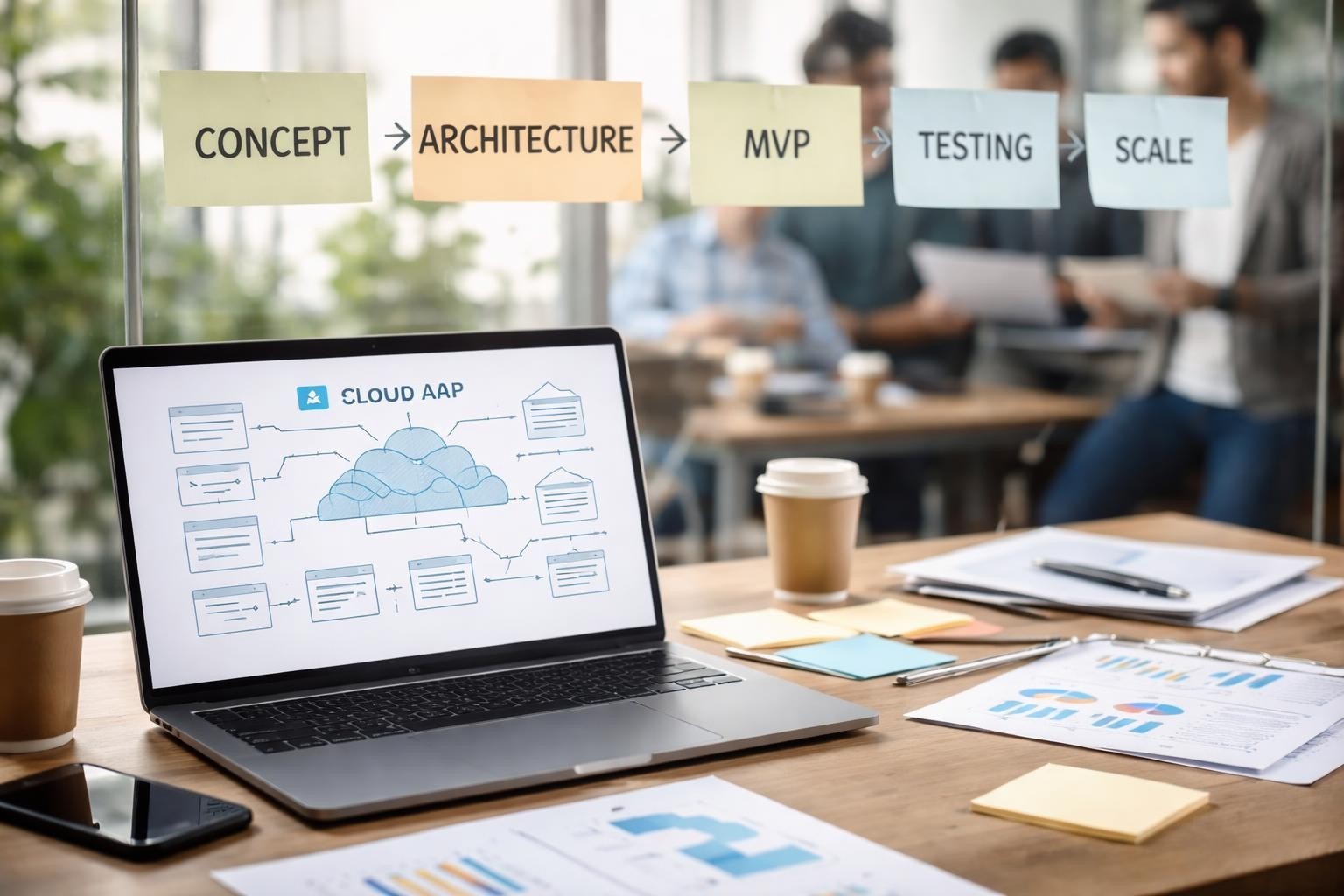
The software-as-a-service model has fundamentally transformed how businesses build and deliver digital products. SaaS app development enables entrepreneurs to create scalable, cloud-based solutions that serve customers globally without the traditional constraints of on-premise software. For founders and startups in 2026, understanding the core principles and best practices of building SaaS applications is essential for creating products that compete effectively in an increasingly crowded marketplace. This guide explores the strategic and technical considerations that separate successful SaaS products from those that struggle to gain traction.
Understanding the SaaS Development Landscape
SaaS app development differs significantly from traditional software creation. Rather than building standalone applications that users install and manage locally, SaaS products deliver functionality through web browsers or lightweight clients, with all processing and data storage happening in the cloud.
The subscription-based revenue model fundamentally shapes how these applications are architected. Your product must serve multiple customers simultaneously whilst maintaining data isolation, deliver consistent performance as usage scales, and support continuous deployment of new features without disrupting service.
Key characteristics that define modern SaaS applications include:
- Multi-tenant architecture allowing efficient resource sharing
- Subscription-based pricing with recurring revenue streams
- Automatic updates deployed without customer intervention
- Accessible from any device with internet connectivity
- Centralized data management and security protocols
The landscape has evolved considerably over recent years. No-code and low-code platforms have democratized saas app development, enabling entrepreneurs without extensive technical backgrounds to validate ideas and launch products rapidly. Platforms like Bubble.io offer viable alternatives to traditional coding, particularly for MVP development where speed to market matters more than perfect optimization.

Planning Your SaaS Architecture
Architecture decisions made during early development have lasting implications for your product's scalability, maintainability, and operational costs. The foundation you establish determines how easily your application can grow alongside your customer base.
Multi-Tenancy Versus Single-Tenancy
The multi-tenant versus single-tenant decision represents one of the most consequential architectural choices in saas app development. Multi-tenant architecture serves multiple customers from a single application instance, sharing infrastructure whilst maintaining logical data separation. This approach maximizes resource efficiency and simplifies updates, as changes deploy once for all customers.
Single-tenant architecture provides each customer with a dedicated instance. Whilst this increases infrastructure costs and complicates updates, it offers stronger isolation and enables customer-specific customization that some enterprises require.
For startups and early-stage products, multi-tenant architecture typically provides the better foundation. The operational efficiency and simplified maintenance outweigh the benefits of single-tenancy for most use cases.
Microservices Versus Monolithic Architecture
| Architecture Type | Advantages | Challenges | Best For |
|---|---|---|---|
| Monolithic | Simpler initial development, easier debugging, lower operational complexity | Difficult to scale specific features, tight coupling, longer deployment cycles | MVPs, small teams, simple applications |
| Microservices | Independent scaling, technology flexibility, fault isolation | Complex orchestration, distributed system challenges, higher operational overhead | Mature products, large teams, complex domains |
The microservices approach has gained significant traction for SaaS applications requiring independent scaling of different components. However, the added complexity makes microservices problematic for early-stage products where requirements remain uncertain and team size is limited.
Starting with a well-structured monolith that maintains clear boundaries between different functional areas provides a pragmatic middle path. This approach delivers faster initial development whilst enabling future migration to microservices as specific components require independent scaling.
Building Security into Your SaaS Foundation
Security cannot be an afterthought in saas app development. Data breaches, unauthorized access, and compliance failures destroy customer trust and create existential risks for young companies. Security in SaaS applications must address threats ranging from phishing attacks to SQL injection and cross-site scripting.
Authentication and authorization form your first line of defence. Implement robust identity and access management from the start:
- Multi-factor authentication (MFA) should be available for all accounts, mandatory for administrative access
- Role-based access control (RBAC) limits user permissions based on their organizational role
- Session management enforces timeout policies and detects suspicious login patterns
- OAuth 2.0 integration enables secure third-party authentication without handling passwords directly
Data Protection and Encryption
Encryption protects data both in transit and at rest. Transport Layer Security (TLS) should encrypt all communication between clients and your servers. Database encryption prevents unauthorized access even if storage media is compromised.
Consider what data truly requires collection and storage. Each additional data point increases both your security obligations and regulatory compliance burden. Implement data retention policies that automatically purge unnecessary information.
Essential security practices for SaaS applications:
- Regular security audits and penetration testing
- Automated vulnerability scanning integrated into deployment pipelines
- Dependency management to patch known security issues promptly
- Comprehensive logging and monitoring for suspicious activity
- Incident response plans detailing procedures for potential breaches
Implementing robust security measures requires ongoing attention rather than one-time implementation. Security threats evolve constantly, demanding regular updates to your protective measures.
Optimizing User Experience and Interface Design
User experience fundamentally determines whether customers adopt, continue using, or abandon your SaaS product. Best practices in SaaS product design emphasize reducing friction at every stage of the user journey.
The onboarding experience deserves particular attention. New users form impressions within minutes that influence long-term retention. Streamlined sign-up processes, progressive disclosure of features, and contextual guidance help users achieve their first success quickly.
Sign-Up and Onboarding Optimization
- Minimize required fields during initial registration
- Offer social login options alongside email registration
- Provide immediate value before requesting payment information
- Use interactive tutorials that demonstrate core functionality
- Implement progress indicators for multi-step processes
Navigation should remain intuitive even as your feature set expands. Consistent interface patterns, clear information hierarchy, and responsive design that adapts to different devices all contribute to positive user experiences.
Performance directly impacts user satisfaction. Pages should load within two seconds under normal conditions. Implement lazy loading for images and content that appears below the initial viewport. Use content delivery networks (CDN) to serve static assets from geographically distributed servers.

Implementing Scalability from the Start
Scalability challenges often catch growing SaaS companies unprepared. Applications that perform adequately with dozens of users experience degradation when serving thousands. Planning for growth during initial saas app development proves far easier than retrofitting scalability later.
Database Architecture for Growth
Database design significantly impacts scalability. Proper indexing accelerates query performance as data volumes increase. Caching frequently accessed data reduces database load and improves response times.
Consider database replication for read-heavy workloads. Directing read queries to replica databases whilst reserving the primary database for writes distributes load effectively. For write-heavy applications, database sharding partitions data across multiple servers based on specific criteria.
Infrastructure and Auto-Scaling
Cloud infrastructure providers offer auto-scaling capabilities that adjust resources based on demand. Configure scaling policies that add capacity before performance degrades rather than reacting to existing problems.
Scalability strategies across application layers:
- Application tier: Stateless application servers enabling horizontal scaling
- Database tier: Read replicas, connection pooling, query optimization
- Storage tier: Object storage for user uploads, CDN for static assets
- Cache tier: Redis or Memcached for session data and frequently accessed content
Load balancing distributes incoming requests across multiple application instances, preventing any single server from becoming a bottleneck. Health checks automatically remove failing instances from the rotation.
Development Methodologies for SaaS Products
Agile development methodologies align naturally with saas app development. The iterative approach enables rapid response to user feedback and market changes. Short development cycles, typically two to four weeks, maintain momentum whilst allowing regular course corrections.
Continuous integration and continuous deployment (CI/CD) automate testing and deployment processes. Code changes trigger automated test suites that validate functionality before deployment. Successful tests automatically deploy changes to production environments, reducing time between development and user availability.
MVP development approaches emphasize validating core assumptions with minimal investment. Building a focused feature set that addresses your target market's primary pain point enables faster learning and reduces wasted effort on unvalidated ideas.
For entrepreneurs looking to validate concepts rapidly, partnering with specialists in MVP Development can accelerate the journey from idea to market-ready product, particularly when internal technical expertise is limited.
| Development Phase | Timeline | Key Objectives | Success Metrics |
|---|---|---|---|
| Discovery & Planning | 1-2 weeks | User research, feature prioritization, technical architecture | Clear requirements document, validated assumptions |
| MVP Development | 4-8 weeks | Core feature implementation, basic UI/UX | Functional prototype, user testing feedback |
| Beta Launch | 2-4 weeks | Limited user testing, bug fixes, refinement | User engagement rates, critical bug resolution |
| Public Launch | Ongoing | Marketing, user acquisition, feature expansion | User growth, retention rates, revenue metrics |
Integration and API Strategy
Modern SaaS applications rarely operate in isolation. Integration capabilities determine how easily your product fits into customers' existing workflows and technology ecosystems. Building SaaS applications with comprehensive API strategies enables both internal extensibility and external partnerships.
RESTful APIs provide standard interfaces for programmatic access to your application's functionality. Well-documented APIs with clear authentication requirements and rate limiting enable customers to automate workflows and build custom integrations.
Webhook Implementation
Webhooks push real-time notifications to external systems when specific events occur within your application. This event-driven approach enables responsive integrations without requiring constant polling.
Consider which third-party services your target market commonly uses. Native integrations with popular platforms-accounting software, CRM systems, communication tools-reduce friction during customer evaluation and increase product stickiness.
Essential integration considerations:
- Authentication methods (API keys, OAuth, JWT tokens)
- Rate limiting to prevent abuse and ensure fair resource allocation
- Versioning strategy for backwards compatibility
- Comprehensive documentation with code examples
- Monitoring and analytics for API usage patterns
Testing and Quality Assurance
Comprehensive testing prevents bugs from reaching production whilst building confidence in your codebase. Different testing types address specific concerns across the development lifecycle.
Unit tests validate individual functions and components in isolation. Integration tests verify that different parts of your application work together correctly. End-to-end tests simulate real user workflows, ensuring complete features function as intended.
Automated testing provides continuous validation as your codebase evolves. Tests that execute with every code change catch regressions immediately, when they're cheapest to fix. Manual testing remains valuable for exploratory testing and evaluating user experience qualities that resist automation.
Performance testing under realistic load conditions identifies bottlenecks before they impact real users. Gradually increasing simulated traffic reveals at what point your infrastructure begins to degrade, informing capacity planning decisions.
Monitoring and Observability
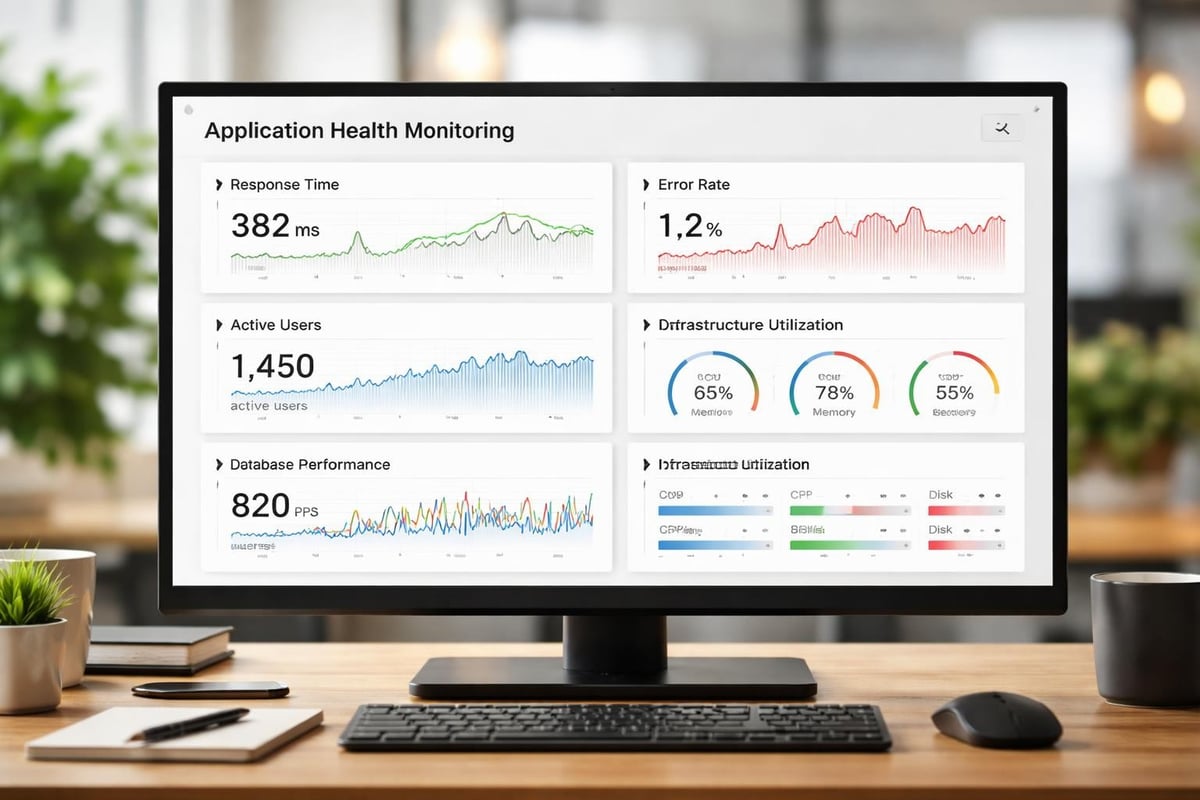
Production monitoring provides visibility into how your application performs under real-world conditions. Comprehensive observability enables rapid diagnosis when problems occur and identifies optimization opportunities before they become critical.
Key Metrics to Track
- Application performance: Response times, error rates, throughput
- Infrastructure health: CPU utilization, memory consumption, disk I/O
- Business metrics: Active users, feature adoption, conversion rates
- User experience: Page load times, client-side errors, user flows
Application performance monitoring (APM) tools trace requests through your application stack, identifying slow database queries, external API calls, or computational bottlenecks contributing to poor performance.
Error tracking systems aggregate exceptions and errors, providing context about the conditions that triggered failures. Stack traces, user sessions, and environment details enable efficient debugging.
Pricing Strategy and Billing Implementation
Pricing strategy significantly influences customer acquisition, retention, and revenue. Common SaaS pricing models include per-user pricing, tiered feature access, usage-based billing, or hybrid approaches combining multiple factors.
Billing implementation requires careful attention to edge cases. Proration calculations for mid-cycle plan changes, failed payment handling, and dunning workflows to recover failed charges all impact revenue realization.
Subscription Management Considerations
- Trial period management with automated conversion workflows
- Plan upgrade and downgrade procedures with appropriate proration
- Payment failure handling including retry logic and customer notification
- Cancellation workflows that gather feedback whilst enabling account reactivation
- Invoice generation and delivery for customers requiring formal documentation
Third-party billing platforms like Stripe, Paddle, or Chargebee handle payment processing, subscription management, and compliance requirements, allowing development teams to focus on core product functionality rather than reinventing payment infrastructure.
Compliance and Regulatory Considerations
SaaS applications handling customer data must comply with relevant regulations. Requirements vary based on geographic markets served and data types processed.
The General Data Protection Regulation (GDPR) affects any SaaS product serving European customers. Key requirements include obtaining explicit consent for data collection, enabling data portability, providing deletion capabilities, and reporting breaches within 72 hours.
Industry-specific regulations impose additional requirements. Healthcare applications must comply with HIPAA in the United States. Financial services applications face regulations including PCI DSS for payment card processing and various financial reporting requirements.
Compliance implementation checklist:
- Privacy policy and terms of service addressing regulatory requirements
- Data processing agreements for customers acting as data controllers
- Consent management systems tracking user permissions
- Data export functionality enabling portability
- Right to deletion workflows for account and data removal
- Audit logging for regulatory reporting requirements
Launch and Go-to-Market Strategy
Technical excellence means little without effective go-to-market execution. Planning your app launch requires coordinating product readiness, marketing preparation, and support infrastructure.
Beta programs with selected early adopters provide valuable feedback whilst generating testimonials and case studies for broader marketing. Limit initial beta group size to ensure you can provide responsive support and incorporate feedback rapidly.
Pre-Launch Preparation
Building anticipation before public launch creates initial momentum. Email list building, content marketing demonstrating expertise, and strategic partnerships with complementary products all contribute to stronger launch results.
Documentation quality directly impacts customer success. Comprehensive help documentation, video tutorials, and searchable knowledge bases reduce support burden whilst enabling customer self-service. Consider what questions your beta users asked most frequently and ensure documentation addresses those topics thoroughly.
Support infrastructure should scale with your user base. Start with email support and consider adding live chat as volume increases. Help desk software organizes incoming requests and ensures timely responses.
Iterating Based on User Feedback
Post-launch development should prioritize learning over feature accumulation. Usage analytics reveal which features customers actually use versus those that seemed important during planning. Best practices for SaaS development emphasize continuous improvement driven by real user behaviour.
Customer feedback channels should be diverse and accessible. In-app feedback widgets, user interviews, survey campaigns, and support ticket analysis all provide different perspectives on product performance and user needs.
Feature prioritization frameworks help evaluate competing demands. The RICE framework scores initiatives based on Reach, Impact, Confidence, and Effort, enabling data-informed decisions about development priorities. Jobs-to-be-Done analysis focuses on understanding the underlying problems users hire your product to solve rather than accepting feature requests at face value.
SaaS app development in 2026 demands balancing technical architecture, user experience, security, and business strategy to create products that solve real problems whilst scaling sustainably. The principles outlined here-from multi-tenant architecture and robust security through continuous deployment and user-centred design-provide a foundation for building competitive SaaS applications. Whether you're a technical founder building your first product or an entrepreneur validating a concept, partnering with experienced specialists can accelerate your path to market. Creator Concepts helps founders transform ideas into scalable MVPs, combining technical expertise with deep understanding of the startup journey to deliver products that validate assumptions and drive growth.