

The application development business landscape has transformed dramatically over the past decade, with 2026 marking a pivotal moment for entrepreneurs and startups. Traditional development approaches are giving way to innovative methodologies that prioritize speed, cost-effectiveness, and market validation. For founders looking to enter this space, understanding the current dynamics of an application development business is essential to building sustainable competitive advantage.
The application development business has shifted from being purely technical to becoming a strategic enabler of innovation. Organizations are no longer satisfied with lengthy development cycles that take months or years to deliver results.
Today's market demands rapid iteration and validated learning. Developers have evolved into business enablers, aligning technical solutions with strategic objectives rather than simply writing code. This transformation has created opportunities for specialized agencies that understand both the technical and business dimensions of application creation.
The numbers tell a compelling story about the viability of an application development business in 2026:
| Market Segment | Projected Value | Growth Driver |
|---|---|---|
| Custom Application Development | $53.7 billion increase (2025-2029) | Cloud adoption and AI integration |
| Tech Consulting | Over $400 billion globally | Digital transformation demand |
| Application Development Software | Continued expansion | No-code and low-code platforms |
The custom application development service market is experiencing unprecedented growth, driven by organizations seeking competitive differentiation through bespoke solutions. This expansion creates fertile ground for nimble agencies that can deliver value quickly.
Specialization has become the cornerstone of successful application development businesses. Rather than attempting to serve every market segment, focused agencies build deep expertise in specific verticals or methodologies.
Key specialization strategies include:
The most successful application development business models combine technical excellence with business acumen. Understanding your client's market, competition, and growth trajectory enables you to deliver solutions that generate measurable business outcomes rather than simply functional software.

Minimum Viable Product development has become the gold standard for application development businesses serving startups and entrepreneurs. This methodology reduces risk by validating core assumptions before significant investment.
An MVP-focused application development business helps founders test market demand with functional prototypes rather than fully-featured applications. This approach aligns perfectly with lean startup principles and modern venture capital expectations.
For entrepreneurs seeking to validate their ideas using scaleable MVPs, partnering with specialized agencies delivers faster time-to-market and reduced development costs. The key is building enough functionality to test hypotheses whilst maintaining flexibility for rapid iteration based on user feedback.
The rise of no-code platforms represents the most significant shift in the application development business model since the advent of cloud computing. Platforms like Bubble.io, Webflow, and Adalo have democratized application creation whilst simultaneously creating new opportunities for specialized agencies.
Benefits of no-code for application development businesses:
No-code doesn't eliminate the need for expertise. Successful application development businesses leverage these platforms to deliver sophisticated solutions that would be prohibitively expensive using traditional development approaches. The focus shifts from writing code to architecting systems, designing user experiences, and integrating complex business logic.
When implementing third-party API integrations in Bubble.io apps, technical knowledge remains essential. The difference is that this knowledge can be applied more efficiently, allowing small teams to deliver enterprise-grade solutions.
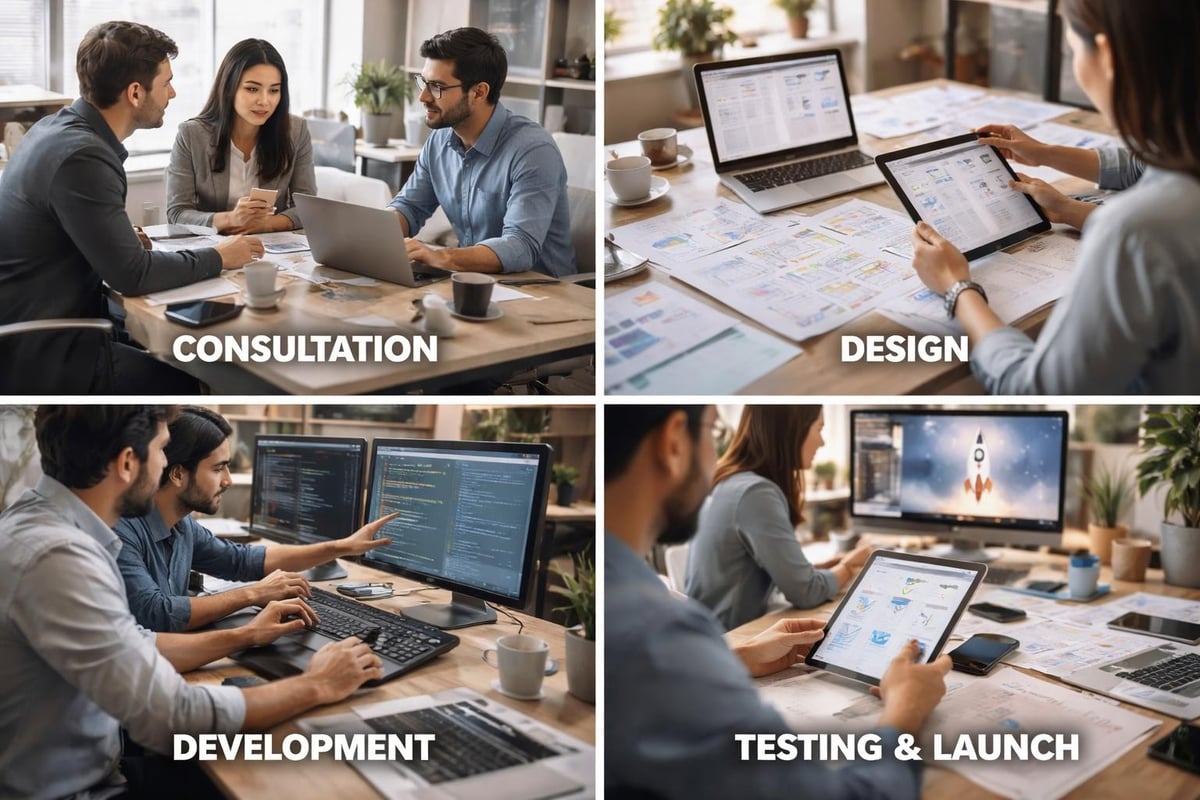
Today's application development business must offer more than coding skills. Clients expect comprehensive support throughout the product lifecycle.
A competitive service portfolio should address the complete journey from concept to launch:
The most valuable application development business models integrate business strategy with technical execution. Understanding market positioning, competitor analysis, and go-to-market strategy enables agencies to deliver applications that succeed commercially, not just technically.
Choosing the right pricing structure affects both profitability and client relationships:
| Pricing Model | Best For | Advantages | Challenges |
|---|---|---|---|
| Fixed Project | Defined scope MVPs | Budget certainty | Scope creep risk |
| Monthly Retainer | Ongoing development | Predictable revenue | Requires clear deliverables |
| Value-Based | Strategic partnerships | Aligned incentives | Complex to structure |
| Equity Partnership | Early-stage startups | Upside potential | Cash flow impact |
Many application development businesses combine models, using fixed pricing for initial MVPs and transitioning to retainers for ongoing enhancement. This hybrid approach provides security whilst enabling long-term client relationships.
Technical credibility forms the foundation of any successful application development business. Clients need confidence that their chosen partner can deliver robust, scalable solutions.
Best practices for application development include establishing coding standards, implementing comprehensive error handling, and optimizing performance across all user scenarios. These fundamentals apply whether building custom code or leveraging no-code platforms.
Professional application development businesses implement systematic quality assurance:
Quality isn't an afterthought but an integrated aspect of the development process. Managing application growth effectively requires establishing these practices from the first project and maintaining them consistently across all client engagements.
Market positioning determines which clients you attract and the premium you can command. Generic "we build apps" messaging struggles against specialized competitors with clear value propositions.
Effective positioning strategies:
An application development business serving entrepreneurs building SaaS applications should communicate differently than one targeting enterprise digital transformation. Understanding your ideal client profile enables targeted messaging that resonates with decision-makers facing specific challenges.
The application development business landscape continues to evolve rapidly. Staying competitive requires awareness of emerging trends and willingness to adapt service offerings.
Application development trends for 2026 include increased AI integration, mobile-first strategies, and continued adoption of low-code platforms. These shifts create both opportunities and challenges for established agencies.
Artificial intelligence is transforming how application development businesses operate:
The key is viewing AI as an augmentation tool rather than a replacement for human expertise. The most successful application development businesses use these technologies to enhance their capabilities whilst maintaining the strategic thinking and creative problem-solving that clients value.

Organizations are increasingly adopting cloud-native application development, creating demand for agencies skilled in modern architectures. This shift impacts both new projects and legacy system modernization.
An effective application development business helps clients future-proof their applications by building on cloud platforms that support scalability, security, and continuous deployment. Understanding containerization, microservices, and serverless architectures has become essential even when using no-code platforms.
Behind every successful client project lies efficient internal operations. An application development business must manage projects, resources, and client relationships systematically.
Critical operational systems:
Implementing continuous integration and deployment practices enables faster delivery cycles whilst maintaining quality standards. These operational investments differentiate professional agencies from freelancers and casual service providers.
Team structure significantly impacts your application development business's ability to scale:
The optimal structure depends on your growth trajectory, client requirements, and financial position. Many successful application development businesses start with a small core team and expand strategically based on proven demand.
Sustainable growth requires consistent client acquisition combined with strong retention. The economics of an application development business improve dramatically when clients return for additional projects or ongoing development work.
Effective acquisition channels include:
Client retention starts with exceptional delivery but extends to proactive relationship management. Regular check-ins, performance reviews, and strategic planning sessions keep your application development business top-of-mind when new opportunities arise.
Building transformative digital solutions for startups creates natural opportunities for ongoing partnerships as those companies grow and require additional features or new products.
Financial sustainability requires more than simply pricing projects profitably. Understanding unit economics, cash flow management, and strategic investment ensures long-term viability.
Key financial metrics for application development businesses:
| Metric | Target Range | Why It Matters |
|---|---|---|
| Gross Margin | 60-75% | Indicates pricing and cost efficiency |
| Client Acquisition Cost | <20% of lifetime value | Measures marketing effectiveness |
| Project Completion Rate | >90% | Reflects estimation accuracy |
| Repeat Business Percentage | >40% | Shows client satisfaction |
| Cash Reserves | 3-6 months operating expenses | Provides stability during gaps |
With the global tech consulting market projected to exceed $400 billion in 2026, opportunities abound for well-managed application development businesses. The challenge is capturing your share whilst maintaining healthy margins and sustainable growth rates.
Building a successful application development business in 2026 requires balancing technical excellence with business acumen, specializing in specific markets or methodologies, and staying ahead of industry trends. Whether you're launching your first product or scaling an existing venture, partnering with experienced specialists accelerates your path to market whilst reducing technical risk. Creator Concepts helps founders and startups transform ideas into validated MVPs using no-code platforms, delivering award-winning solutions from our Canary Wharf studio in weeks rather than months.
© 2026 CreatorConcepts Limited
128 City Road, London EC1V 2NX