

The landscape of ai app dev has transformed dramatically over the past few years, with artificial intelligence becoming an essential component rather than a luxury feature. In 2026, entrepreneurs and startups face unprecedented opportunities to build intelligent applications that solve complex problems, yet the technical challenges remain substantial. Understanding the fundamentals of ai app dev whilst navigating the rapidly evolving ecosystem of tools, frameworks, and methodologies is critical for success. This comprehensive guide explores the strategic approaches, practical considerations, and proven methodologies that define successful ai app dev projects today.
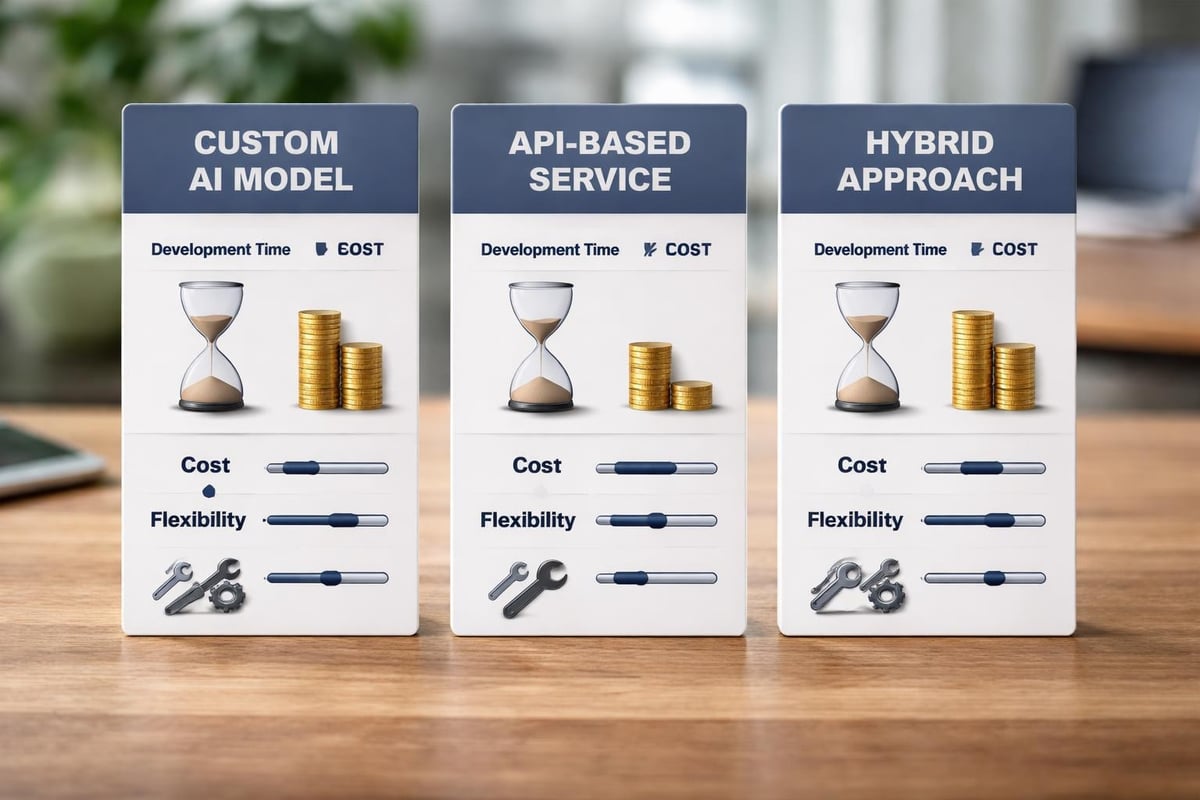
The ai app dev ecosystem has matured significantly, offering founders multiple pathways to integrate intelligence into their applications. Today's landscape includes everything from pre-trained models and API-based services to custom machine learning solutions built from scratch. The choice between these approaches fundamentally shapes development timelines, costs, and capabilities.
Major components of modern ai app dev include:
The methodology you select for ai app dev directly impacts your project's trajectory. Research on AI integration in mobile applications reveals that successful teams carefully evaluate their technical requirements, team capabilities, and business objectives before committing to a specific path. Traditional custom development offers maximum flexibility but requires specialized talent and extended timelines. Conversely, leveraging existing AI services through APIs can dramatically accelerate development whilst reducing technical complexity.
For startups and entrepreneurs, the hybrid approach often delivers optimal results. This strategy combines pre-built AI services for core functionality with custom logic for business-specific requirements. A customer service application might utilize GPT-4 for natural language understanding whilst building proprietary workflows for ticket routing and escalation. This balanced approach allows rapid prototyping without sacrificing differentiation.
Data architecture represents the foundation of successful ai app dev projects. Without robust data collection, storage, and processing capabilities, even the most sophisticated AI models cannot deliver meaningful value. Applications must establish clear data pipelines that ensure quality, consistency, and accessibility throughout the development lifecycle.
| Technical Aspect | Traditional Apps | AI-Enhanced Apps |
|---|---|---|
| Data requirements | Moderate, structured | Extensive, diverse formats |
| Processing power | Standard compute | GPU/specialized hardware |
| Update frequency | Periodic releases | Continuous model retraining |
| Testing complexity | Functional tests | Performance + accuracy metrics |
The principle "garbage in, garbage out" holds particularly true for ai app dev. Best practices for developing and deploying AI applications emphasize that model performance correlates directly with training data quality. Startups must invest early in establishing data validation protocols, cleaning procedures, and quality assurance mechanisms.
Model interpretability has emerged as another crucial consideration. Black-box AI systems that cannot explain their decisions create significant risks in regulated industries and customer-facing applications. Implementing explainable AI (XAI) techniques allows your application to provide transparency, building user trust whilst meeting compliance requirements. This becomes particularly important when developing applications for non-technical founders who need to understand how their intelligent features function.
Security considerations in ai app dev extend far beyond traditional application security. AI systems introduce unique vulnerabilities including model theft, adversarial attacks, and data poisoning. Security risks associated with AI-generated code highlight how modern development practices must adapt to address these emerging threats.
Essential security measures include:
Privacy regulations like GDPR and CCPA impose strict requirements on how AI applications collect, process, and store personal data. Your ai app dev strategy must incorporate privacy by design, ensuring compliance from the initial architecture through deployment. This includes implementing data minimization principles, providing user consent mechanisms, and establishing clear data retention policies.
Most ai app dev projects rely on external services and models, creating dependency risks that require careful management. Service outages, API changes, or pricing modifications from providers like OpenAI, Anthropic, or Google can significantly impact your application. Implementing abstraction layers that allow switching between providers without major code changes provides valuable resilience. Additionally, monitoring costs associated with AI API calls becomes essential, as usage can scale unexpectedly with application growth.

Performance optimization in ai app dev requires balancing response times, accuracy, and operational costs. AI model inference can consume significant computational resources, particularly for complex tasks like image generation or large-scale language processing. Strategies for optimization include model quantization, caching frequent queries, and implementing intelligent request routing based on complexity.
Cost management represents a persistent challenge. Unlike traditional applications with predictable infrastructure costs, AI applications face variable expenses tied to usage patterns and model complexity. Case studies examining AI-assisted code generation demonstrate that even development processes incorporating AI tools require careful monitoring to prevent cost overruns.
Efficient ai app dev workflows separate successful projects from those that struggle with technical debt and escalating costs. Establishing clear processes for model training, evaluation, deployment, and monitoring creates predictability and sustainability. Continuous integration and continuous deployment (CI/CD) pipelines adapted for AI applications should include automated testing of model accuracy, performance benchmarks, and rollback capabilities.
Version control extends beyond code to encompass model versions, training datasets, and hyperparameters. Tools like MLflow and DVC provide specialized capabilities for tracking these AI-specific assets, ensuring reproducibility and facilitating collaboration across development teams.
Common mistakes in AI app development often stem from unrealistic expectations about AI capabilities or insufficient planning for ongoing model maintenance. Many founders assume AI models, once deployed, continue performing optimally indefinitely. In reality, model drift occurs as real-world data patterns evolve, requiring regular retraining and evaluation.
Frequent ai app dev mistakes include:
Scope creep represents another significant risk. The expanding capabilities of AI technologies tempt teams to continuously add features rather than validating core functionality first. This approach contradicts lean startup principles and MVP development methodologies that emphasize rapid validation before expansion. Maintaining focus on solving a specific problem exceptionally well delivers better outcomes than building a mediocre general-purpose AI application.
The ai app dev field moves rapidly, with new models, frameworks, and techniques emerging constantly. Whilst staying informed about advances is valuable, chasing every new technology creates instability and delays. Successful teams establish clear evaluation criteria for adopting new tools, assessing whether innovations provide meaningful benefits for their specific use case. Best practices for AI software development emphasize building on stable, proven technologies for core functionality whilst experimenting with cutting-edge approaches in non-critical areas.
For startups exploring no-code web development platforms, modern tools like Bubble.io increasingly offer AI integration capabilities through plugins and API connectors. This approach democratizes ai app dev, allowing non-technical founders to prototype intelligent features without deep machine learning expertise. However, understanding AI fundamentals remains crucial for making informed decisions about which features to implement and how to structure user interactions.
Ethical considerations in ai app dev have moved from optional to essential. Applications that perpetuate biases, manipulate users, or operate without transparency face growing regulatory scrutiny and public backlash. Incorporating ethical frameworks from project inception ensures your application aligns with societal values whilst mitigating legal and reputational risks.
| Ethical Principle | Implementation Strategy | Measurement Approach |
|---|---|---|
| Fairness | Audit training data for bias | Test across demographic groups |
| Transparency | Provide clear AI disclosure | User comprehension surveys |
| Accountability | Establish human oversight | Incident tracking and review |
| Privacy | Minimize data collection | Privacy impact assessments |
Current trends in incorporating AI into app development emphasize human-centred design that positions AI as an enhancement to user capabilities rather than a replacement for human judgment. Applications should provide clear controls allowing users to understand and influence AI behaviour. This includes offering explanations for AI-generated recommendations, allowing users to correct mistakes, and providing alternative non-AI pathways for critical functions.
Accessibility considerations also deserve attention. AI features that rely heavily on visual or auditory inputs may exclude users with disabilities unless alternative interaction methods are provided. Ensuring your ai app dev process includes accessibility testing and diverse user feedback creates more inclusive applications that serve broader audiences.
Scaling represents a distinct challenge in ai app dev compared to traditional applications. As user numbers grow, AI inference costs and computational requirements can increase dramatically. Research on rapid mobile app development for AI agents demonstrates that architectural decisions made during initial development significantly impact scalability potential.
Scalability strategies include:
Cloud infrastructure provides flexibility for scaling AI applications, but costs can escalate quickly without proper governance. Establishing budgets, implementing automated alerts, and regularly reviewing resource utilization prevents financial surprises whilst maintaining performance standards.
Forward-thinking ai app dev includes planning for success. Your architecture should accommodate increased data volumes, additional AI features, and geographic expansion without requiring complete rebuilds. Modular design that separates AI components from core business logic facilitates updates and improvements without disrupting the entire application. This approach mirrors principles used in building scaleable MVPs designed for growth.
Documentation becomes increasingly important as applications scale. Comprehensive documentation of model architectures, training procedures, and integration patterns enables team expansion and knowledge transfer. This proves particularly valuable when bringing on specialized AI talent or working with development partners who need to understand existing systems quickly.

Testing ai app dev projects requires methodologies beyond traditional quality assurance approaches. Whilst functional testing remains important, AI applications demand additional evaluation of model accuracy, fairness, robustness, and performance under various conditions. Establishing comprehensive test suites that assess both technical functionality and AI-specific behaviours ensures reliable application performance.
Unit testing AI components focuses on validating individual model inputs and outputs, ensuring transformations and preprocessing steps function correctly. Integration testing verifies that AI components interact properly with databases, APIs, and user interfaces. However, the probabilistic nature of AI models means tests must account for acceptable variance rather than expecting identical outputs for given inputs.
Model performance naturally degrades over time as real-world conditions diverge from training data. Implementing continuous monitoring systems that track accuracy metrics, prediction confidence, and user feedback allows early detection of performance issues. When metrics fall below acceptable thresholds, automated retraining workflows can update models using recent data, maintaining application quality without manual intervention.
A/B testing provides valuable insights into how AI features impact user behaviour and business metrics. Testing variations of model outputs, recommendation algorithms, or AI-driven interfaces reveals which approaches deliver optimal results. This data-driven methodology aligns with startup best practices that emphasize validated learning and iterative improvement.
Successful ai app dev requires collaboration between diverse skill sets including data scientists, software engineers, UX designers, and domain experts. Establishing clear communication channels and shared objectives prevents silos that undermine project success. Cross-functional teams that include both AI specialists and business stakeholders make better decisions about which problems to solve and how to measure success.
For startups and small teams, hiring full-time AI specialists may not be feasible initially. Alternative approaches include partnering with AI consultancies, leveraging freelance expertise for specific components, or utilizing AI services that abstract technical complexity. The key is matching your team structure to project requirements whilst maintaining quality standards.
The rapidly evolving nature of ai app dev makes ongoing learning essential. Establishing practices for knowledge sharing, whether through regular technical discussions, documentation repositories, or training sessions, keeps teams current with best practices and emerging techniques. This investment in team capability building pays dividends through improved decision-making and reduced reliance on external experts.
Documentation standards should cover not only code but also model cards that describe AI component purposes, capabilities, limitations, and ethical considerations. These artifacts provide crucial context for team members, stakeholders, and auditors, ensuring everyone understands how AI features function and their appropriate use cases.
Most ai app dev projects involve integrating AI capabilities into existing application ecosystems rather than building from scratch. This integration presents unique challenges around data compatibility, authentication, latency, and error handling. Planning integration points carefully and establishing clear interfaces between AI and non-AI components minimizes disruption and facilitates maintenance.
Legacy system integration often requires data transformation layers that convert between formats used by existing systems and those required by AI models. These transformations must handle edge cases gracefully, providing fallback behaviours when AI services are unavailable or return unexpected results. Building resilience into integrations ensures applications remain functional even when AI components experience issues.
Working with Bubble.io for app building demonstrates how modern platforms simplify AI integration through plugin ecosystems and API connectors. These tools abstract infrastructure complexity, allowing developers to focus on business logic whilst leveraging powerful AI capabilities. However, understanding underlying integration principles remains valuable for troubleshooting and optimization.
The convergence of accessible AI technologies and rapid development methodologies has created unprecedented opportunities for entrepreneurs to build intelligent applications that solve meaningful problems. Success in ai app dev demands balancing technical sophistication with practical business considerations, maintaining focus on user value whilst navigating a complex and evolving landscape. By following established best practices, avoiding common pitfalls, and maintaining ethical standards, founders can build AI applications that deliver genuine value whilst remaining sustainable and scaleable. If you're ready to bring your intelligent application concept to life, Creator Concepts specialises in helping entrepreneurs validate their ideas through award-winning MVP development, transforming vision into working applications within weeks rather than months.
© 2026 CreatorConcepts Limited
128 City Road, London EC1V 2NX