

The landscape of application development has transformed dramatically over the past few years, with mobile no code platforms democratising access to technology creation. Entrepreneurs and startups no longer need extensive programming knowledge or large development teams to bring their mobile app ideas to life. This shift represents a fundamental change in how businesses approach digital product development, particularly for those seeking to validate concepts quickly and cost-effectively. The rise of visual development tools has opened doors for non-technical founders to compete in the mobile app marketplace whilst maintaining control over their product vision and development timeline.
Traditional mobile app development historically demanded specialised skills in languages such as Swift for iOS or Kotlin for Android. Development teams required months of work to create even basic applications, with costs frequently exceeding £50,000 for simple MVPs.
Mobile no code platforms have disrupted this model entirely. According to research on no-code development fundamentals, these platforms enable creators to build sophisticated applications through visual interfaces rather than writing code line by line. This transformation has reduced development timelines from months to weeks, and in some cases, days.
The technology underlying these platforms has matured significantly. Modern mobile no code solutions offer:
The startup ecosystem has particularly embraced this movement. Founders face constant pressure to validate ideas quickly whilst managing limited resources. Mobile no code development addresses both concerns simultaneously.
Consider the typical startup journey. A founder identifies a market opportunity, secures initial funding, and needs to demonstrate traction to investors within six months. Traditional development approaches consume this entire runway on technical buildout alone. No code alternatives compress this timeline, allowing founders to test market hypotheses whilst capital remains available for marketing and customer acquisition.
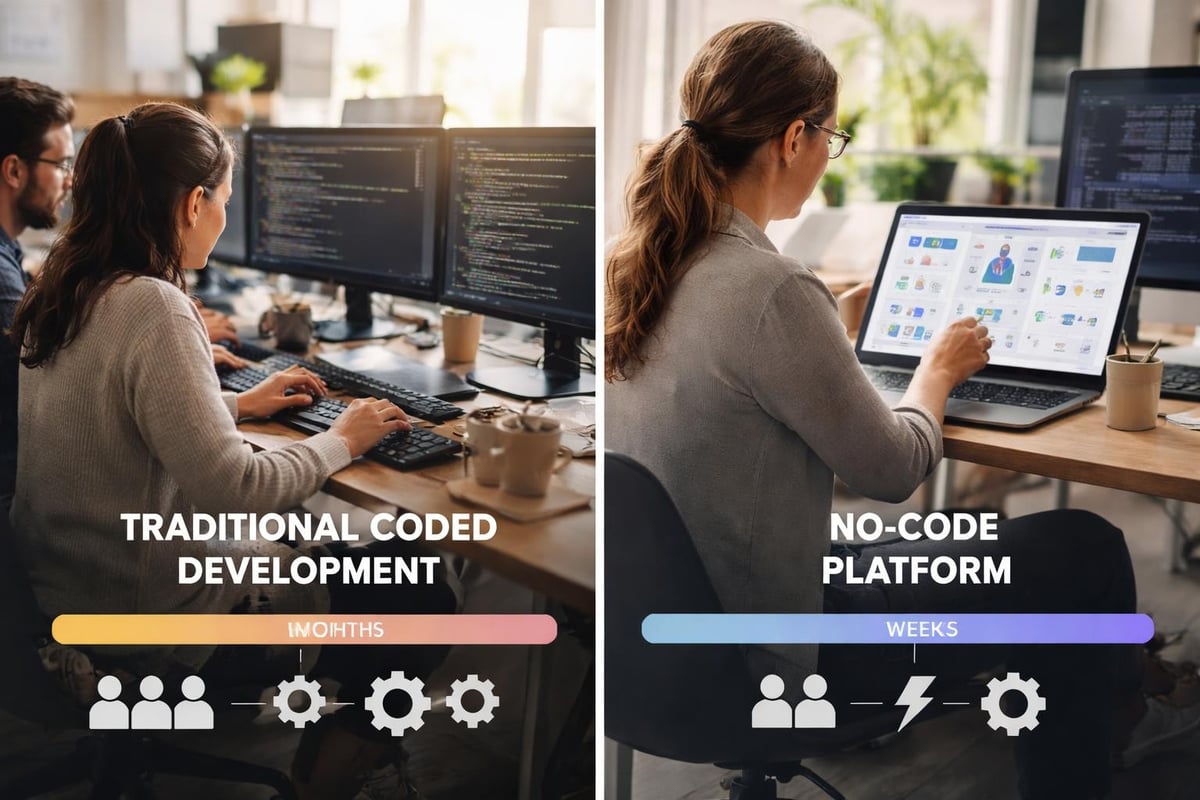
Beyond speed, mobile no code platforms offer financial advantages that resonate with bootstrapped founders. The comparison between low-code and no-code platforms reveals that no code solutions eliminate the need for dedicated mobile developers during the MVP phase, redirecting those funds toward user research and growth experiments.
The mobile no code ecosystem encompasses various platforms, each with distinct strengths and target audiences. Understanding these options enables founders to select tools aligned with their specific requirements.
| Platform Type | Best For | Key Strength | Limitation |
|---|---|---|---|
| Visual builders | Custom workflows | Flexibility | Learning curve |
| Template-based | Speed to market | Rapid deployment | Less customisation |
| Database-first | Data-heavy apps | Complex relationships | Design constraints |
| Design-focused | Consumer apps | Beautiful interfaces | Technical features |
A critical decision in mobile no code development involves choosing between native applications and progressive web apps (PWAs). Native apps, built with platforms like Adalo or FlutterFlow, compile to actual iOS and Android applications distributed through app stores. PWAs, conversely, function through web browsers whilst offering app-like experiences.
Native mobile no code solutions provide superior performance and access to device features such as cameras, GPS, and push notifications. However, they require separate submissions to Apple's App Store and Google Play Store, each with distinct review processes and guidelines.
The guide on building mobile apps without coding emphasises that native apps deliver better user experiences for consumer-facing products, whilst PWAs suit internal tools and B2B applications where app store distribution isn't critical.
The process of creating a mobile application without coding follows a structured methodology that ensures both speed and quality. Understanding this framework prevents common pitfalls that derail first-time builders.
Successful mobile no code projects begin with thorough planning, not immediate building. Define your core value proposition in a single sentence. Identify the minimum features required to demonstrate this value. Everything else constitutes scope creep.
Create wireframes using tools like Figma or even paper sketches. These visual blueprints clarify user flows before you invest time in the platform itself. Many founders waste weeks building features that seemed important but prove unnecessary during user testing.
Focus on these essential elements first:
The development approach used by agencies like Creator Concepts demonstrates how proper planning accelerates mobile no code projects. Their MVP Development service helps founders validate ideas using scaleable MVPs designed, built, and launched in weeks rather than months, proving that strategic preparation outweighs rushed execution.
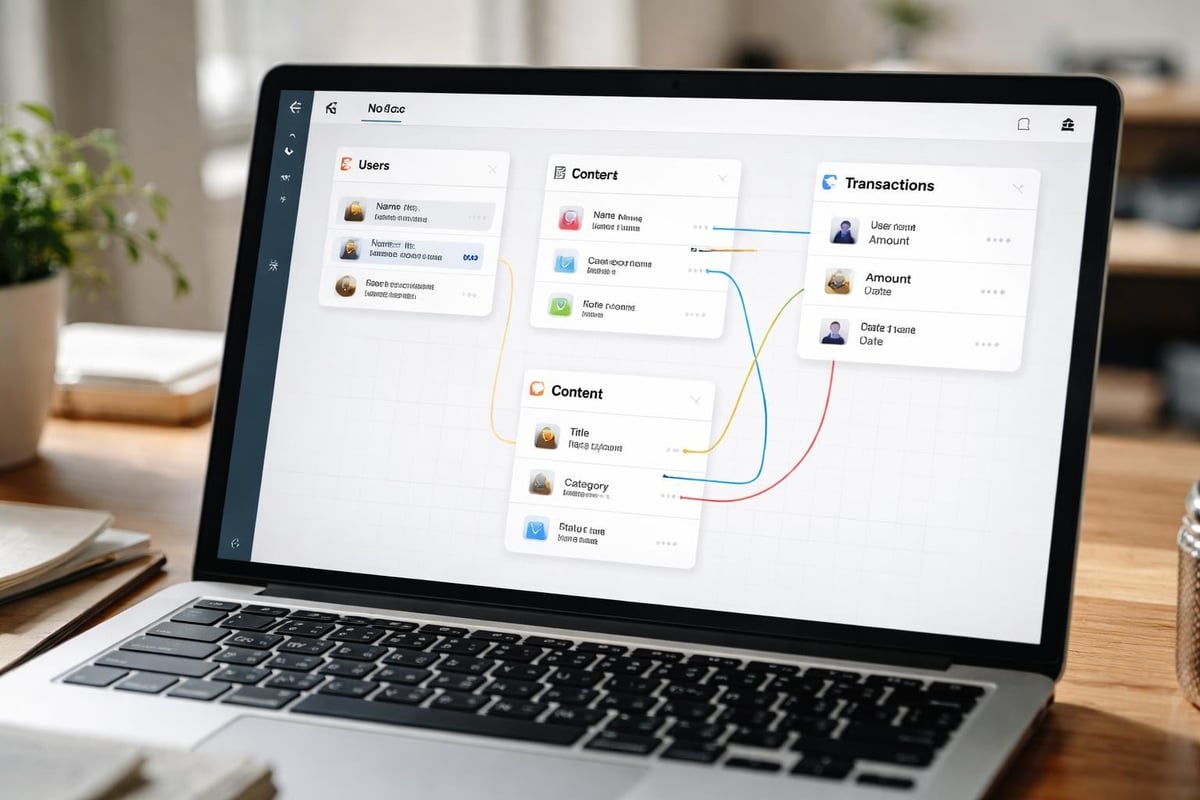
Perhaps the most underestimated aspect of mobile no code development involves data architecture. Your database structure determines what your application can accomplish both now and as it scales.
Think in terms of tables and relationships. A marketplace app requires at least four tables: Users, Products, Orders, and Reviews. Each table contains fields (User table includes name, email, location), and relationships connect them (each Order links to one User and multiple Products).
Most mobile no code platforms use visual database designers where you create these structures through dropdown menus rather than SQL queries. However, the thinking process remains identical to traditional development. Poor data architecture creates technical debt that compounds with every new feature.
Modern mobile no code solutions extend far beyond basic CRUD (Create, Read, Update, Delete) operations. Understanding these advanced capabilities separates amateur projects from professional applications.
The power of mobile no code development multiplies when connecting to external services via APIs. Payment processing through Stripe, email automation via SendGrid, and SMS notifications through Twilio all integrate without custom coding.
Most platforms offer pre-built connectors for popular services. For custom APIs, visual API configuration tools allow you to map endpoints, define authentication methods, and parse responses through interface builders. This capability means your mobile no code app can leverage the entire internet of services.
| Integration Type | Common Use Cases | Complexity Level |
|---|---|---|
| Payment gateways | Subscriptions, purchases | Low |
| Email services | Notifications, marketing | Low |
| Cloud storage | File uploads, media | Medium |
| AI/ML APIs | Content moderation, recommendations | Medium |
| Custom backends | Legacy systems, specialised data | High |
The discussion around web apps and mobile apps highlights how integration capabilities often determine whether a product can effectively serve its market. Mobile applications rarely exist in isolation; they form parts of broader ecosystems.
Security concerns frequently arise when discussing mobile no code platforms. Sceptics question whether visual builders can match the security standards of traditional development. The reality proves more nuanced.
Reputable platforms handle security fundamentals automatically. User passwords undergo hashing and encryption. Database access follows role-based permissions. SSL certificates secure data transmission. These measures, which traditional developers must implement manually, come built into mobile no code platforms.
However, security extends beyond technical implementation to design decisions. Will your app require two-factor authentication? How will you handle forgotten passwords? What data can users access, modify, or delete? These questions demand thoughtful answers regardless of development approach.
Creating a functional app represents just the beginning. Professional mobile no code applications demand attention to performance, design consistency, and user experience refinement.
Users form impressions within seconds of opening your application. Navigation structure significantly influences these initial judgements. Mobile no code platforms provide standard navigation patterns: tab bars, hamburger menus, stack navigation, and modal presentations.
Choose patterns based on content depth and frequency of access. Tab bars suit applications with 3-5 primary sections users access regularly. Hamburger menus work for apps with numerous options accessed occasionally. Stack navigation handles hierarchical content like e-commerce catalogues.
Consistency matters more than cleverness. Users bring expectations from thousands of other apps they've used. Deviation from established patterns creates friction, regardless of how innovative your approach seems.
Mobile no code applications can suffer performance issues when builders neglect optimisation. Large images slow loading times. Excessive database queries drain battery life. Poorly structured workflows create lag.
Address these concerns through:
The article on app development for non-technical founders emphasises that performance optimisation shouldn't wait until post-launch. Building efficiently from the start prevents the need for costly refactoring later.
Testing distinguishes hobbyist projects from market-ready applications. Mobile no code platforms simplify development but don't eliminate the need for rigorous quality assurance.
Before public launch, beta testing reveals issues invisible during solo development. Recruit 10-20 users representing your target demographic. Provide them with test builds and structured feedback mechanisms.
TestFlight for iOS and Google Play's internal testing for Android enable distribution to beta testers without public release. Monitor crash reports, gather user feedback, and observe actual usage patterns through analytics.

Key metrics during beta testing include:
Launch doesn't signal completion; it marks transition to continuous improvement. Mobile no code platforms excel here because updates deploy without app store resubmission for many changes. Backend logic, workflows, and data structures update instantly.
However, changes to native functionality, new permissions, or modified app descriptions require new store submissions. Plan update cycles balancing rapid iteration with the 1-3 day review periods imposed by app stores.
The guide exploring no-code platforms for mobile apps reinforces that successful apps evolve based on user data rather than founder assumptions. Analytics tools integrated into mobile no code platforms provide the insights driving these iterations.
Revenue generation determines whether your mobile no code application survives beyond initial enthusiasm. Multiple monetisation models suit different app categories and audiences.
Subscription revenue provides predictable income that investors and financial planners appreciate. Mobile no code platforms integrate with payment processors to handle recurring billing, though implementation requires careful planning.
Consider these subscription variations:
In-app purchases suit content-driven applications. Users pay for individual items (ebooks, courses, virtual goods) rather than ongoing access. This model works particularly well for games, educational content, and marketplace applications.
| Monetisation Model | Best App Types | Implementation Difficulty |
|---|---|---|
| Subscriptions | SaaS, productivity tools | Medium |
| In-app purchases | Games, marketplaces | Medium |
| Advertising | Content apps, free utilities | Low |
| Affiliate commissions | Review sites, comparison tools | Low |
| Service fees | Marketplaces, booking platforms | High |
Determining optimal pricing involves experimentation rather than guessing. Mobile no code platforms allow rapid price testing that traditional development makes impractical. Launch with conservative pricing, then test increases with new user cohorts whilst grandfathering existing subscribers.
Psychological pricing principles apply regardless of development approach. £9.99 outperforms £10.00 despite the penny difference. Annual subscriptions at £99 (equivalent to £8.25 monthly) convert better than £10 monthly when presenting both options. The comparison between no-code and traditional development for SaaS notes that pricing flexibility represents a key advantage of rapid development cycles.
Success creates new challenges. As your mobile no code application gains users, technical and operational demands intensify. Planning for scale prevents crisis management during growth phases.
Mobile no code platforms handle impressive scale, with many supporting thousands of concurrent users. However, certain thresholds signal potential transitions to custom development.
Consider custom development when:
However, many founders transition prematurely, abandoning mobile no code platforms before exhausting their capabilities. The article on whether Bubble remains worthwhile in 2026 provides framework for evaluating when platforms meet needs versus when custom solutions become necessary.
Modern mobile no code projects often employ hybrid architectures. The mobile interface remains no code whilst custom backend services handle specific intensive operations. This approach maximises speed and cost-efficiency whilst addressing platform limitations.
For instance, a photo-sharing app might use a mobile no code platform for user interface and basic functionality whilst leveraging custom image processing services for filters and effects. API connections bridge these components, with each element using the most appropriate technology.
Technical excellence means nothing without users. Mobile no code development's speed advantage extends beyond building; it enables rapid marketing experimentation that traditional timelines prohibit.
Both Apple's App Store and Google Play Store function as search engines requiring optimisation. Your app name, subtitle, description, and keywords determine discoverability for users searching relevant terms.
Research competing apps in your category. Identify keywords they target and search volumes for those terms. Tools like App Annie or Sensor Tower provide competitive intelligence unavailable through app stores directly.
Critical ASO elements include:
The discussion on launching apps successfully emphasises that launch represents a marketing event, not merely technical deployment. Coordinate ASO, press outreach, and community engagement around release dates.
Sustainable growth for mobile no code applications comes from product-driven acquisition rather than paid advertising alone. Growth loops embed acquisition into core functionality.
Consider how Dropbox offered additional storage for referrals. The product itself became the marketing channel. Each user who referred friends received value whilst expanding the user base. This mechanism scaled user acquisition without proportionally scaling marketing costs.
Design growth loops into your mobile no code application from inception. Sharing features, collaborative elements, and network effects all create organic distribution. The article covering community app development tools explores how community-driven features inherently encourage user invitation and engagement.
Even with powerful mobile no code platforms, certain mistakes derail projects. Understanding these patterns prevents wasted time and resources.
The ease of adding features in mobile no code platforms paradoxically creates problems. Traditional development's friction (time, cost, complexity) naturally limits scope. When adding features requires mere minutes, builders succumb to "just one more thing" syndrome.
Combat scope creep through ruthless prioritisation. Every feature carries costs beyond development time: maintenance burden, user interface complexity, and opportunity cost of not building something else. The MoSCoW method (Must have, Should have, Could have, Won't have) provides framework for feature decisions.
Critics of mobile no code development cite platform lock-in as primary concern. If you build extensively on a proprietary platform, migration to different technology becomes difficult. This risk exists but warrants perspective.
Traditional development creates different lock-ins: specific programming languages, frameworks, and developer expertise. No development approach offers perfect portability. The question isn't whether lock-in exists, but whether the platform's trajectory aligns with your needs.
Mitigate platform risk through:
The mobile no code revolution has fundamentally altered who can participate in application development, democratising access to technology creation for entrepreneurs without technical backgrounds. This transformation enables faster validation, reduced costs, and greater control over product direction throughout the startup journey. Whether you're a first-time founder exploring your initial concept or an established business expanding into mobile, these platforms offer compelling advantages that traditional development struggles to match. If you're ready to transform your mobile app idea into reality without the complexity and cost of traditional development, Creator Concepts specialises in helping entrepreneurs and startups launch award-winning MVPs using the most powerful no code platforms available today.
© 2026 CreatorConcepts Limited
128 City Road, London EC1V 2NX